The questions you can ask depend on the tools you have
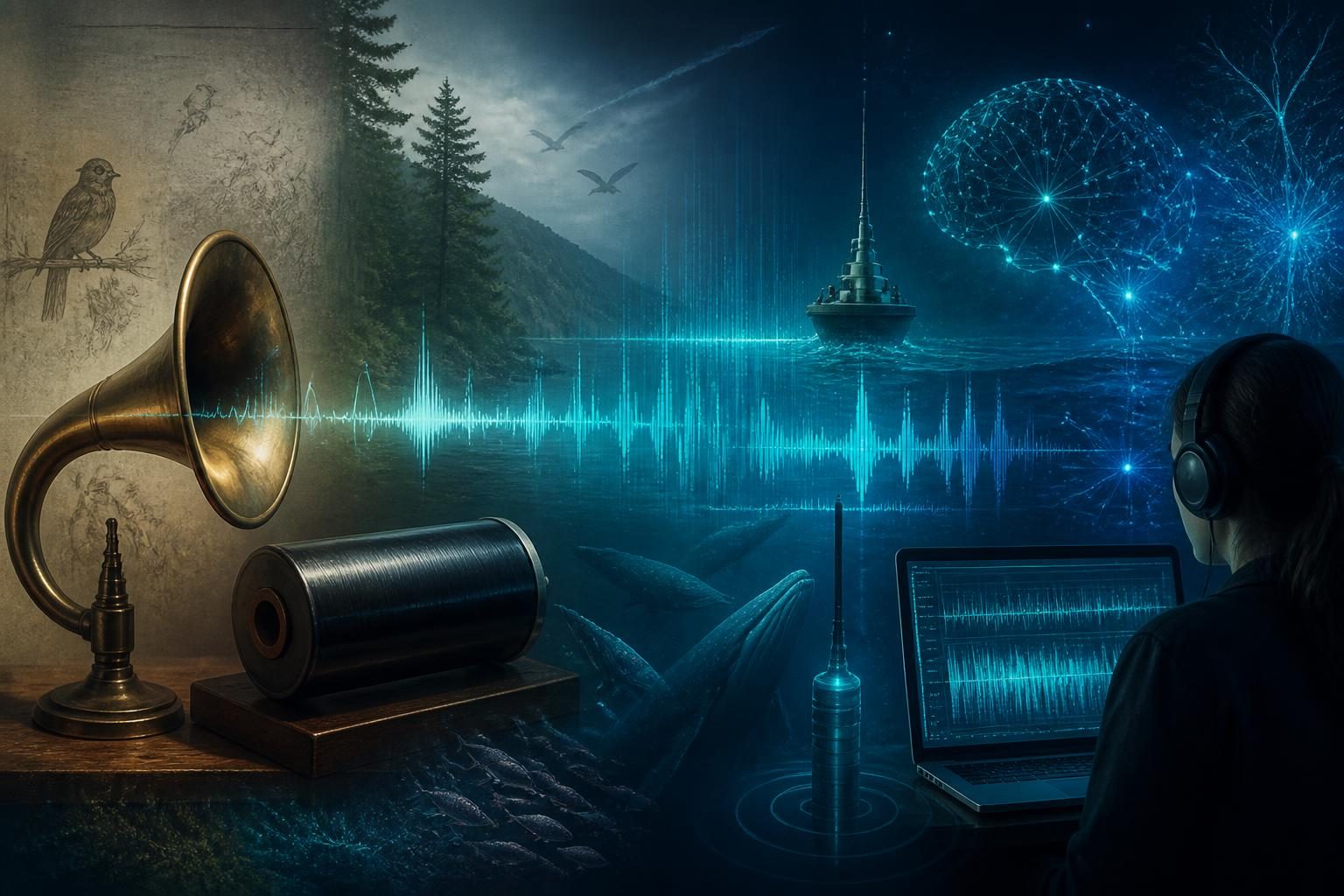
Every era of animal communication research has been shaped, and limited, by its instruments. What scientists could ask about animal sound has always depended on what they could capture, see, and measure. Trace the history of bioacoustics and you're really tracing a sequence of technological leaps, each of which didn't just answer old questions but made entirely new ones thinkable. Understanding that arc is the best way to see clearly where we stand now — and to stay humble about it.
First, you have to capture it
For most of human history, animal sound was ephemeral. You heard it, and then it was gone. You could describe it, imitate it, write it in words or crude notation — but you couldn't hold it, replay it, or compare two instances precisely. The study of animal communication in any rigorous sense simply couldn't exist, because its subject vanished the moment it occurred.
The first great leap was recording itself. Once sound could be captured and replayed — first mechanically, then electronically — a recording could be listened to repeatedly, shared between researchers, and preserved. This sounds obvious now, but it was transformative: for the first time, the same animal sound could be examined by different people at different times, which is a precondition for science. The pioneers who lugged heavy, temperamental recording gear into forests and out to sea built the foundation everything else stands on.
Then, you have to see it
Capturing sound made it repeatable; it didn't make it analyzable in fine detail. Human hearing is remarkable but fleeting and hard to quantify. The second great leap was visualization — turning sound into a picture you could study at leisure. The development of the spectrogram, which renders sound as a two-dimensional image of time, frequency, and energy, changed the field profoundly. Suddenly you could see the structure of a call, measure it, compare it, and describe it precisely. Bird song revealed its architecture; whale song revealed its themes and phrases. Whole discoveries became possible simply because sound had become visible.
This is worth dwelling on, because it seeded a subtle habit that persists: we began to trust the picture. And as discussed elsewhere on this blog, the spectrogram is an instrument with choices baked in, not a neutral photograph. The leap to visualization was enormous and enabling — and it also introduced a way to be confidently misled, if you forget that the image is a reconstruction. Every powerful new tool arrives with its own new ways to fool yourself.
Then, you have to organize it at scale
For decades, the bottleneck moved from capturing and seeing to reviewing. Recording became easy; analysis stayed manual. A researcher listened, marked, measured, and compared by hand — expert, rigorous, and impossibly slow relative to the flood of audio that continuous recording could produce. Recordings piled up faster than anyone could analyze them. The questions you could ask were bounded by how much a human could personally review.
The building of great shared archives — vast, organized collections of recordings, contributed by researchers and communities — was a quieter but crucial leap. It pooled the world's captured sound into resources that could ground identification, enable comparison across places and times, and, eventually, train machines. The marine mammal archive assembled from decades of recordings, the enormous bird-sound libraries built partly by a global community of contributors — these turned scattered private tapes into a collective scientific asset. The archive is the unglamorous infrastructure that made the next leap possible.
Finally, the machine learns to listen
The most recent leap is automated analysis — machine-learning models that can sweep through mountains of audio, detect and classify sounds, and surface structure that no human could review by hand. This is the era we're living in: models like BirdNET putting expert-level bird identification in anyone's pocket, and foundation models beginning to generalize across taxa. The bottleneck of manual review is finally breaking, and questions that were once unaskable — about whole populations, long time spans, and continental scales — are coming within reach.
But note the pattern, because it's the whole point of telling the history: each leap expanded what we could do while leaving the standards of evidence exactly where they were. Recording didn't make interpretation trivial. Visualization didn't make the picture infallible. Archives didn't eliminate bias in what got recorded. And automated analysis, for all its power, doesn't understand meaning — it detects and organizes pattern, brilliantly, within the limits of its training. Every generation had a tool that tempted it to overclaim, and every generation's best scientists resisted the temptation.
What the arc teaches about now
Seen against this history, today's moment is thrilling and easy to misread. We have, for the first time, the ability to listen to the living world at planetary scale — continuously, across taxa, mining decades of archived sound with models that improve every year. That's a genuine leap on the order of recording or visualization. It deserves real excitement.
It also deserves the humility the whole arc counsels. The pattern is unbroken: powerful new instruments enlarge the questions we can ask and introduce new ways to fool ourselves, and the honest move is always to use the tool for what it truly does while refusing the overclaim it invites. Automated analysis lets us listen and organize as never before. It has not handed us a translation of what animals mean, and pretending it has would be exactly the mistake every prior era's hype-merchants made with their own new toys.
Standing on the arc
WAVE sits at the current end of this long arc, and tries to honor all of it. It uses the archives the field spent decades building. It relies on visualization while respecting that the picture is a reconstruction. It deploys automated analysis where that's genuinely strong, cross-references where it isn't, and keeps a human in the loop for judgment. And it holds to the one discipline that has separated good bioacoustics from hype in every era: be honest about what the current tools can and cannot do.
The history of listening to animals is a history of steadily better ears — mechanical, then visual, then collective, then computational. Each pair of ears let us ask bigger questions. None of them let us skip the hard, patient work of interpretation. That's the inheritance, and it's a good one: keep building better ears, and keep telling the truth about what you hear.
The pattern worth remembering
If there's one thing to carry away from this history, it's the shape that repeats at every stage. A new instrument arrives — recording, then visualization, then archives, then automated analysis. It dramatically expands the questions researchers can ask. It also introduces a fresh way to be confidently wrong: a recording can be misheard, a spectrogram can be misread, an archive can encode the biases of what got collected, a model can be trusted past its training. And in every era, the difference between good science and hype has been whether people used the new power for what it genuinely did while resisting the overclaim it invited.
That pattern is not a reason for cynicism about the current AI moment; it's a guide for navigating it well. The tools really are getting better, and the questions really are getting bigger. The inheritance from every prior generation is simply this: keep building better ears, and keep telling the truth about what you hear. WAVE tries to be a faithful heir to both halves of that inheritance — pushing the listening as far as the tools honestly allow, and refusing to pretend they allow more.
What comes next, and how to meet it
If the arc holds, the next instruments will again enlarge our questions — richer multimodal sensing, models that reason across taxa and modalities, monitoring at scales we can barely picture now. And if the pattern holds, they will arrive trailing a new set of tempting overclaims. The way to meet that future is the same way the field's best practitioners met every prior leap: adopt the power eagerly, interrogate it honestly, and keep a bright line between what the instrument measures and what we wish it meant. History doesn't guarantee we'll get that balance right, but it does tell us exactly where the danger lies — which is more than most fields get from their own past.
The archives as the field's collective memory
One thread in this history deserves its own emphasis, because it's easy to overlook: the building of shared archives was as important as any single technological leap, and it's the least celebrated. Recording let you capture a sound; visualization let you see it; but the archives let the field remember, pool, and build on its captured sound collectively. Without them, every researcher would be starting from their own private tapes, unable to compare across places and decades, and — crucially — modern machine learning would have had nothing to learn from.
Today's models exist because generations of researchers and community contributors donated recordings into organized, accessible collections. The marine mammal archive built from decades of dedicated recording; the vast bird-sound libraries assembled partly by a global birding community — these are the training data and the ground truth that make automated analysis possible at all. It's a reminder that the field's progress has always been cooperative, and that contributing well-documented recordings back is not charity but investment: the archive that trained today's model is the archive that will train tomorrow's better one. WAVE's choice to connect to these validated, properly attributed sources rather than work in isolation is a way of honoring that collective memory — and depending on it honestly.