A line on a map is not protection
Declaring a protected area is the easy part. The hard part — the part that decides whether the protection is real — is knowing what actually happens inside those boundaries, day after day, across terrain that's often vast, remote, and impossible to patrol continuously. A reserve you can't monitor is a promise you can't keep. And for most protected areas, monitoring has historically meant periodic surveys and stretched-thin patrols: valuable, but sparse snapshots of a place that changes every hour.
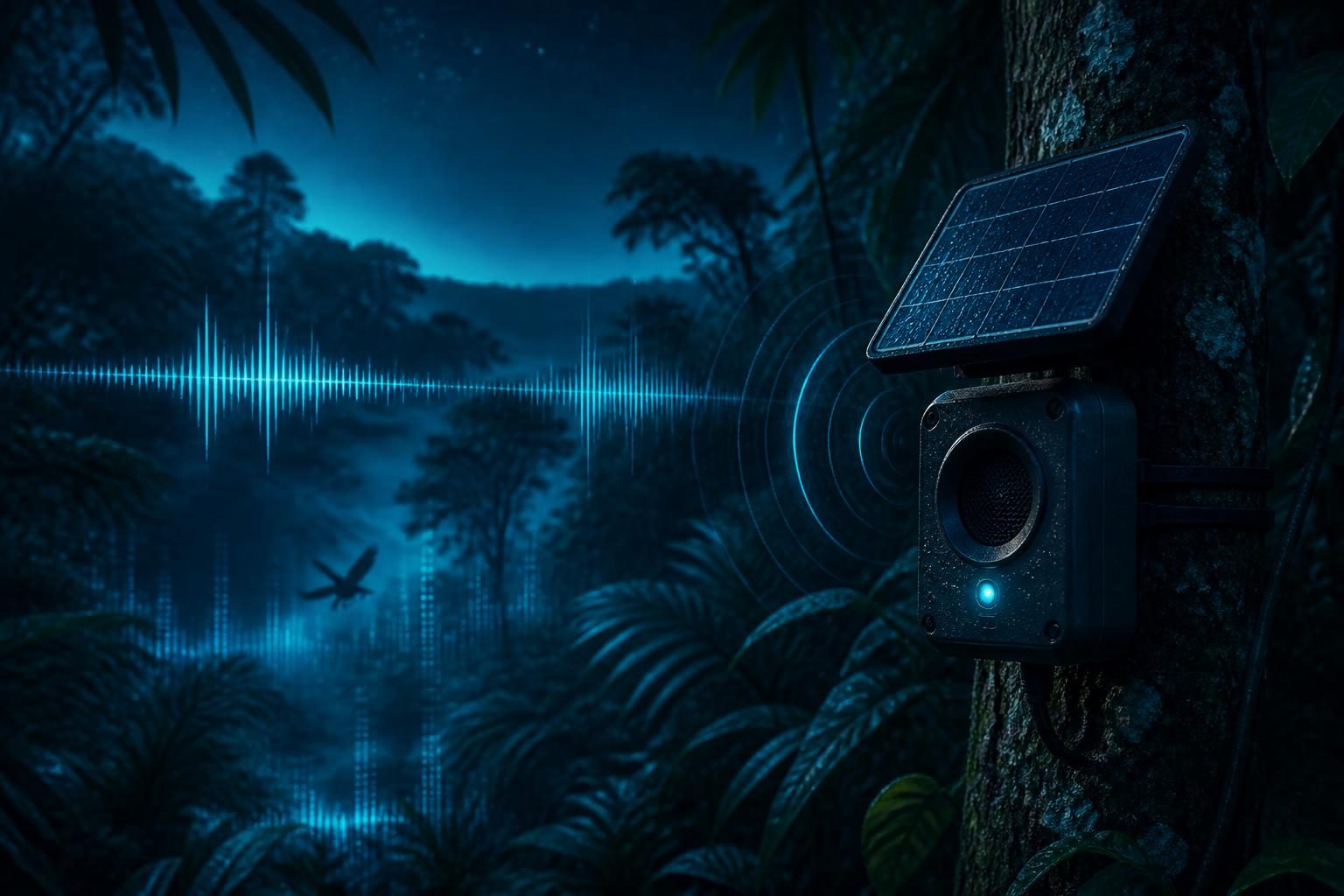
Passive acoustic monitoring is quietly changing this. By deploying recorders that listen continuously, managers can gain something closer to a living readout of a protected area — what's present, how it's changing, and, increasingly, what threats are unfolding. It's one of the most practical and under-appreciated applications of everything bioacoustics has built.
What continuous listening tells a manager
A well-designed acoustic network turns a protected area from a place you visit into a place you monitor. Concretely, it can help answer the questions management actually needs:
- Is the biodiversity holding? Tracking which species are present and how their activity changes over seasons and years gives an ongoing measure of whether the area is doing its job. A dawn chorus that stays rich, a target species that keeps calling, a soundscape that retains its complexity — these are signs of health, captured continuously rather than guessed from occasional visits.
- Are key species using the space? For a reserve created to protect a particular animal, acoustic detection can confirm presence and habitat use across the whole area, including the parts no ranger reaches often.
- Is the soundscape degrading? Rising human noise — traffic, machinery, encroaching activity — shows up in the acoustic record, flagging pressure on the area before it becomes visible damage.
- Is something wrong right now? This is where it gets powerful.
Listening for threats
One of the most compelling frontiers is using sound to detect not just wildlife but threats to wildlife. A protected area's soundscape contains human sounds too, and some of those sounds are the signatures of exactly what the protection is meant to prevent: the report of a gunshot, the whine of a chainsaw, the engine of a vehicle where none should be. Acoustic sensors, in principle, can detect these events and, with a network, help locate them — turning a reserve's own soundscape into an early-warning system against poaching and illegal logging.
The honest framing matters here as much as anywhere. This is a genuinely promising direction, and pilot efforts have shown its potential, but it's not a plug-and-play solution. Detecting a chainsaw reliably across a noisy forest, distinguishing it from false alarms, getting the alert to someone who can act in time — each of these is a real engineering and operational challenge, and the base-rate problem lurks in every rare-event detector. The right posture is that acoustics is becoming a serious tool in the anti-threat toolkit, not that it has solved enforcement.
The dual-use caution, front and center
Threat detection surfaces the ethical tension that runs through all of wildlife tech. A system precise enough to locate a gunshot or a vehicle — or to pinpoint a rare, valuable animal — is a system whose data must be handled with real care, because the same capability that protects can be turned to harm. Precise locations of vulnerable species, and the sensor placements that gather them, are not data to publish casually.
Designing acoustic monitoring for protected areas responsibly therefore means building governance in from the start: controlling who can access sensitive detections, aggregating or delaying information whose misuse is foreseeable, and treating the security of the monitoring system itself as part of the conservation task. A platform that connects to properly attributed sources and keeps sensitive specifics appropriately guarded is practicing a basic duty of care. Power without governance isn't neutral here; it's a liability.
Why this scales where other methods can't
The economic case is what makes acoustic monitoring so well-suited to protected areas specifically. Rangers are expensive, finite, and can't be everywhere; recorders are comparatively cheap, tireless, and duplicable across a landscape. Where the analysis bottleneck once made all that captured audio a burden, automated first-pass analysis now makes it usable — models triage the flood, confidence scores rank where to look, and human experts confirm what matters. The same budget that once bought a few patrol-days can buy continuous coverage of an entire reserve.
This is the through-line of modern bioacoustics applied to conservation's front line: capture continuously, triage automatically, confirm with human judgment, and act. It extends the reach of a limited staff across places and hours they could never physically cover, and it builds a permanent record that grows more valuable as models improve and baselines accumulate.
Honest expectations for a real tool
It would be a disservice to oversell this. Acoustic monitoring won't replace rangers, won't detect silent threats, won't turn a paper park into a real one by itself, and won't produce trustworthy rare-event alerts without the confirmation workflows that manage false positives. It is one powerful layer in a broader conservation strategy — most effective when combined with patrols, satellite data, community engagement, and sound management.
But as a layer, it's a remarkable one. It gives managers something they've never really had: a continuous, non-invasive, scalable ear on the wild places they're charged with protecting. It hears the biodiversity holding or slipping, the soundscape thriving or degrading, and — increasingly — the threats as they unfold. Used with the right expectations and the right safeguards, it makes the line on the map mean more.
The takeaway
A protected area is only as strong as our ability to know what's happening inside it. For most of conservation history, that knowledge was sparse, expensive, and late. Continuous acoustic monitoring is changing that equation — turning reserves into places we can actually listen to, hour by hour, across their whole extent. It's not magic, it carries real ethical weight, and it demands the same honesty about limits that governs all of bioacoustics. But it may prove to be one of the most important tools we have for making the promise of protection real. The wild places are speaking. The future of defending them may depend on how well, and how responsibly, we choose to listen.
From reserve to responsive system
The most exciting long-term vision is a protected area that behaves less like a static boundary and more like a responsive system — one that senses its own condition and can react. Imagine a reserve where a network of sensors continuously feeds a picture of biodiversity health, soundscape quality, and potential threats; where a flagged anomaly can direct a limited patrol to the right place at the right time; where years of accumulated acoustic baselines let managers see slow trends that no single visit could reveal. That's not science fiction — it's the direction the pieces are pointing, as sensors get cheaper, models get better, and the archives of baseline sound grow.
Getting there responsibly is the whole challenge. It means pairing the technology with governance so its power protects rather than exposes the animals; combining it with patrols, satellite data, and community stewardship rather than treating it as a replacement; and holding to honest expectations about false positives and the limits of rare-event detection. Do that, and continuous listening becomes a genuine force multiplier for the people defending the world's wild places — extending their reach across the hours and the terrain they could never otherwise cover, and giving a line on a map the continuous, watchful presence that turns a promise into real protection.
Keeping expectations honest
The fastest way to squander a promising tool is to oversell it, so it's worth restating the limits plainly even while making the case. Acoustic monitoring will not hear silent threats or silent species, will not replace boots on the ground, and will not deliver trustworthy rare-event alerts without the confirmation workflows that tame false positives. It is a layer — a powerful one — in a strategy that still needs patrols, satellite data, community stewardship, and good management. Sold as a silver bullet, it disappoints and discredits itself. Deployed as a force multiplier with clear-eyed expectations and real data governance, it delivers something conservation has never had at this scale: a continuous, non-invasive, affordable ear on the wild places we've promised to protect.
The permanent record, quietly accumulating
One under-appreciated benefit deserves a closer look: the acoustic archive a protected area builds simply by listening. Every day of recording adds to a permanent record that grows more valuable over time. A soundscape captured this year becomes the baseline against which next year's is judged; audio analyzed today with current models can be re-analyzed tomorrow with better ones, extracting new findings from old recordings without a single additional field day. A reserve that listens continuously is, in effect, accumulating an ever-deepening memory of itself.
That memory is a strategic asset. It lets managers detect slow trends that no periodic survey could reveal, prove the effect of interventions, and hand successors a rich historical record rather than a set of disconnected snapshots. It also future-proofs the investment: as classification improves and as broad-taxa models mature, the same archive keeps yielding more. In a field where the recordings outlive the recorders and the models, the decision to listen well now is a gift to whoever manages the place a decade from now — and to the animals whose continued presence, or troubling absence, that record will faithfully document.