The sky is full of sound you can't hear
On a summer evening, the air above you may be crisscrossed with intense, rapid-fire calls — a whole aerial ecosystem of sound — and you'll hear almost none of it. Most bats communicate and navigate using ultrasound: frequencies above roughly 20 kilohertz, the ceiling of human hearing, often ranging far higher. Where elephants exploit the long reach of very low frequencies, bats have gone the opposite direction, into a high-frequency world purpose-built for a completely different task: seeing with sound.
Bats are the textbook case of biological sonar, and studying them is a distinct discipline within bioacoustics — with its own gear, its own analysis headaches, and its own hard-won honesty about what the recordings can and can't tell you.
Echolocation: perception by echo
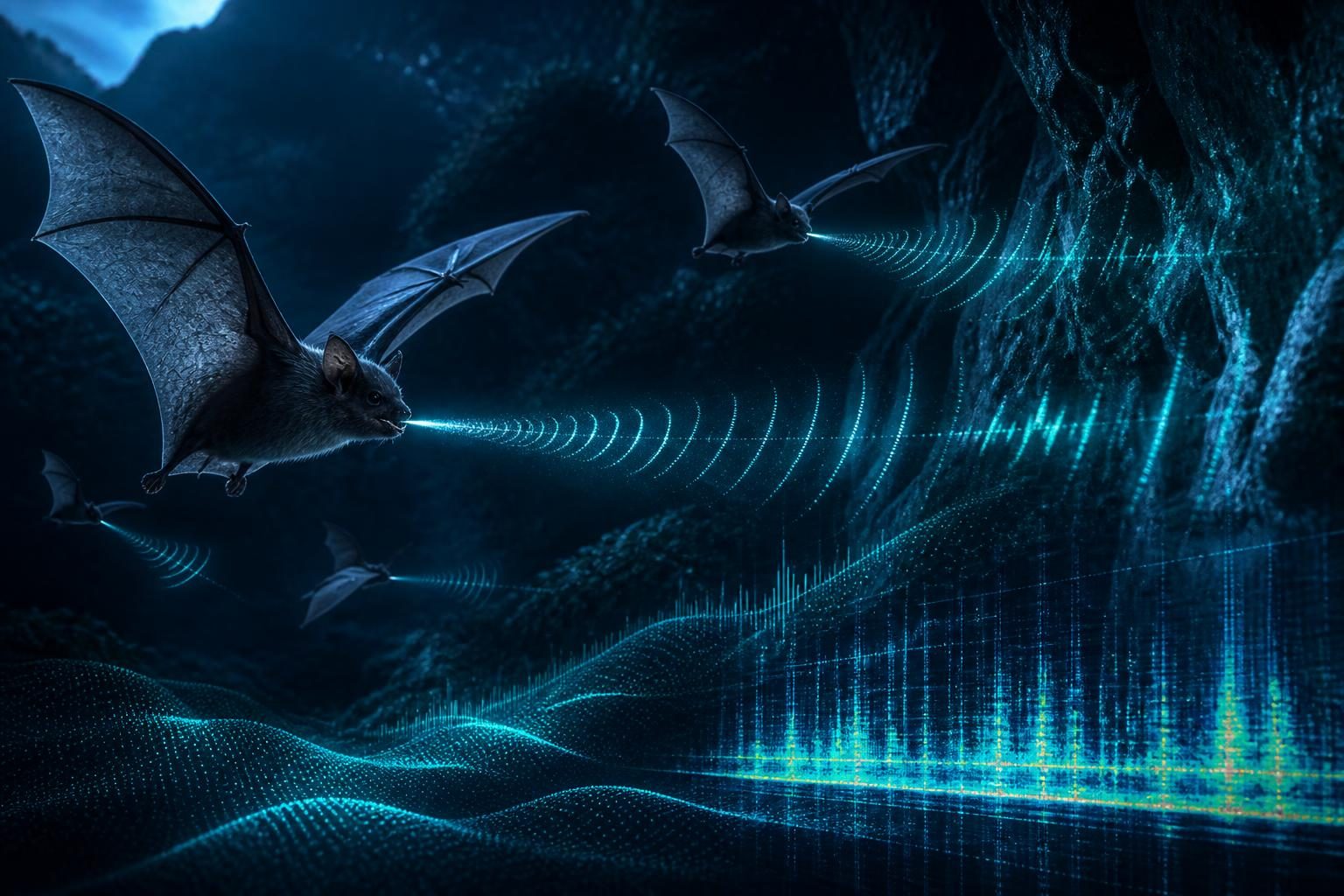
The core of most bats' acoustic life is echolocation. A bat emits a call and listens to the echo bouncing back off its surroundings, reconstructing a detailed picture of the world — the location, distance, size, texture, and even motion of objects, including the tiny insects it hunts. It's active sensing: the animal produces the sound whose return it interprets, the opposite of passive listening.
Why ultrasound? Physics again, but pointing the other way from elephants. High frequencies have short wavelengths, and short wavelengths resolve small objects. To detect and track something as small and fast as a flying insect, a bat needs the fine spatial resolution that only high frequencies provide. The trade-off is range — ultrasound attenuates quickly — but for close-in aerial hunting, resolution beats reach. Evolution picked the tool that fit the job.
The calls themselves are structured with striking precision. Many bats sweep through a range of frequencies within a single call; the pattern, duration, and repetition rate change with what the bat is doing. A bat cruising in open air, searching, uses one call style; closing on prey, it shifts into a rapid "feeding buzz," a burst of calls that ramps up as it homes in. The acoustic signature of a hunt is legible if you know how to read it — which is part of what makes bat bioacoustics so rich.
Not just sonar: the social channel
It's a common oversimplification to treat bat calls as only echolocation. Bats also produce social calls — signals used in communication rather than navigation, tied to mating, territory, mother-offspring contact, and group coordination. These are a different acoustic register from the echolocation pulses, and disentangling the two is part of the analytical challenge. A recording of a roost or a foraging area is a layered mixture of navigation and conversation, and reading it means separating the animal talking to the world from the animal talking to other bats.
As always, the honest boundary holds: we can characterize call types and correlate them with behavior far better than we can claim to know their precise "meaning." The structure is measurable; the interpretation is careful inference.
The recording challenge: catching the ultrasonic
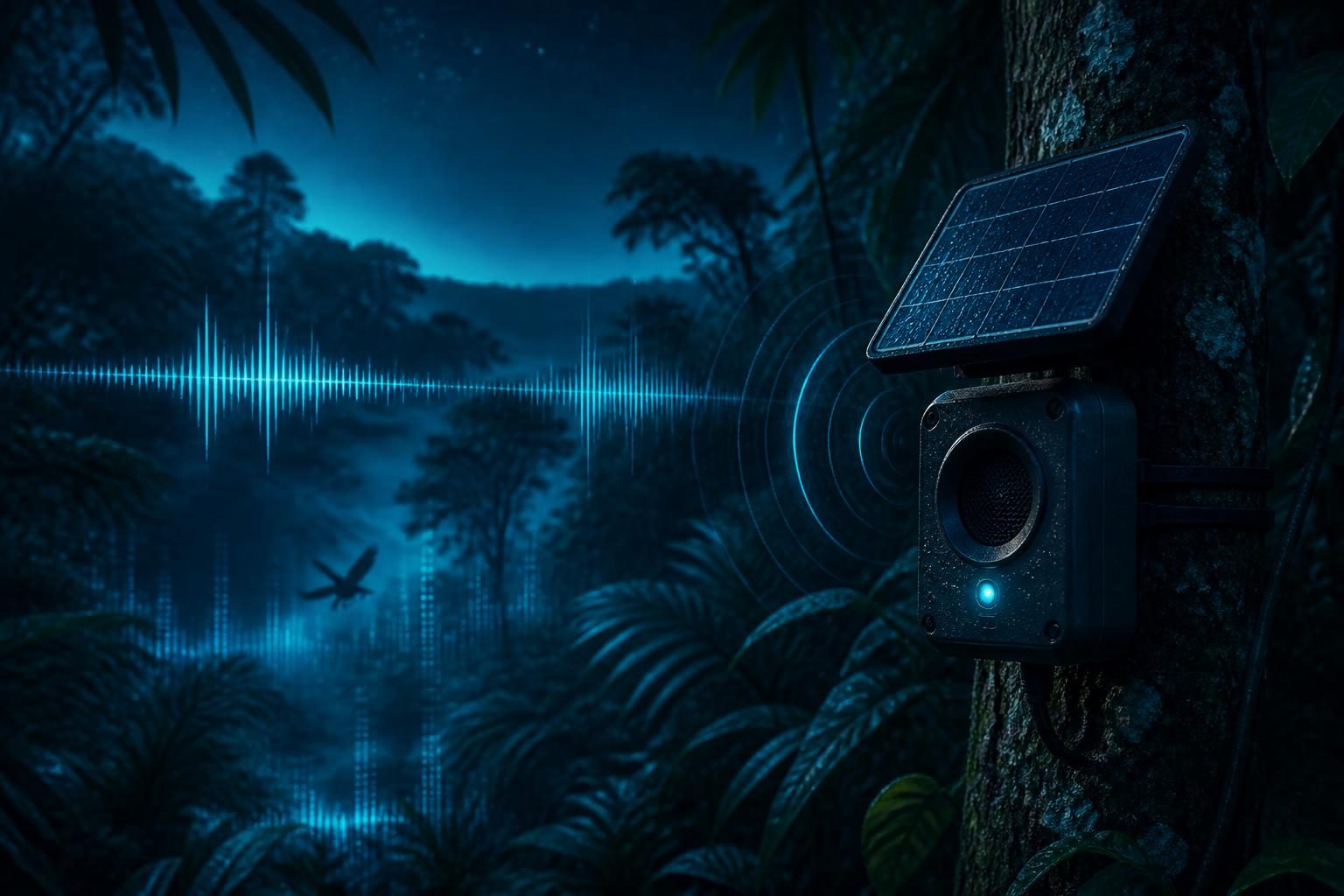
Recording bats forces you past ordinary equipment. Standard microphones and recorders roll off well before the frequencies bats use; you need gear designed for ultrasound, sampling fast enough to capture it faithfully. (There's a hard rule here: to record a frequency accurately, you must sample at more than twice it — so ultrasonic work demands very high sample rates, which in turn means more data and more storage per minute of recording.)
Because humans can't monitor ultrasound directly, the field developed clever workarounds — devices that shift bat calls down into audible range so a person can hear them in the field, in various flavors that trade off fidelity for immediacy. These are wonderful for detection and for the sheer thrill of hearing the hidden aerial world. But they transform the signal, and serious analysis works from full-fidelity recordings, not the shifted-down monitoring version. Knowing which you're looking at is part of not fooling yourself.
Classification: harder than it looks
Automatically identifying bats by their calls is an active, and genuinely difficult, area of bioacoustics — and a useful reality check on the limits of acoustic classification generally. Several factors conspire to make it hard:
- Species overlap. Different species can produce similar calls, and a single species can vary its calls depending on context and environment. The neat one-species-one-signature assumption often breaks down.
- The Doppler and behavior problem. A bat's calls change as it flies, closes on prey, or maneuvers among clutter. The "same" bat sounds different moment to moment, which confounds naive matching.
- Regional variation. Call characteristics can vary geographically, so a classifier trained in one region may stumble in another.
- Data gaps. As with every taxon outside the best-studied birds, labeled ultrasonic reference data is unevenly available, and thin data means blind spots.
The result is that bat classification, done responsibly, leans heavily on confidence being treated as evidence rather than verdict, and on expert confirmation for anything that matters. It's a vivid illustration of a truth WAVE builds around: a classifier's reliability depends on how closely your recording resembles what it was trained on, and outside that comfort zone it will still produce confident-looking numbers that deserve scrutiny, not trust.
Why bats are worth the trouble
Bats are ecologically vital — major predators of night-flying insects, pollinators, seed dispersers — and they're under serious pressure from habitat loss, disease, and other threats. Acoustic monitoring is one of the best tools available for tracking them precisely because they're small, nocturnal, fast, and hard to survey any other way. Their calls announce their presence and activity to a well-placed ultrasonic sensor, enabling non-invasive monitoring of species that would otherwise be nearly impossible to census.
That conservation value is exactly why getting the technology and the honesty right matters. Overclaiming a bat identification can seed false records; underinvesting in proper ultrasonic gear can miss species entirely. The discipline — right equipment, full-fidelity recordings, confidence read as evidence, expert confirmation — is what turns the ultrasonic frontier from a novelty into a serious monitoring tool.
The frontier, honestly framed
The ultrasonic world is a reminder, from the opposite end of the spectrum, of the same lesson the infrasonic world teaches: our unaided hearing captures a narrow slice of the natural soundscape, and the animals living above and below that slice have evolved communication and sensing far richer than our senses suggest. Bats hunt by painting the dark with sound and reading the echoes; they gossip in a register we'll never hear without instruments; and they do it all in the ordinary air above our heads.
Building the ears to detect that world — and the discipline to interpret it honestly — is the whole project. The sky is full of sound. The frontier is learning to hear it well enough to help the animals making it, without pretending we understand more than we do.
The feeding buzz, read like a story
One of the most satisfying things in bat bioacoustics is that a recording can tell a narrative if you learn its grammar. A bat in open-air search mode spaces its calls out, sampling the world at a relaxed cadence. When it detects prey and begins to close, the calls speed up. In the final approach, they collapse into the rapid burst known as a feeding buzz — the acoustic fingerprint of a hunt reaching its climax. Read across a night of recording, these patterns reveal not just which bats were present but what they were doing: cruising, hunting, socializing, commuting.
That behavioral legibility is a reminder that acoustic data, well understood, carries far more than a species checklist. It carries activity, and activity is what conservation often most needs to know — is this habitat merely being passed over, or actively used for foraging? The sound holds the answer, for those who can read it and are careful not to over-read it.
A discipline that keeps you honest
Bats are, in a sense, the field's built-in humility lesson. Everything that makes acoustic classification hard shows up in them at once: overlapping species signatures, context-dependent calls, regional variation, and thin reference data in places. Work with bats for a while and you internalize the habits that make all bioacoustics trustworthy — demand full-fidelity recordings, treat a confident classification as a lead to confirm rather than a fact to file, and stay acutely aware of the boundary between characterizing a call and claiming to know its meaning. Those habits, forged in the ultrasonic frontier, are exactly the ones a responsible platform carries into every other corner of the animal kingdom.
The takeaway
The ultrasonic world sits in plain air above our heads, dense with navigation and conversation we can't hear. Detecting it well means matching our instruments to the animal's register rather than our own, working from full-fidelity recordings, and treating every classification as a lead to confirm. Do that, and acoustic monitoring becomes one of the best ways to watch over ecologically vital, hard-to-survey animals. Do it carelessly, and the confident numbers a classifier produces on difficult, overlapping bat calls will quietly lead you astray. The frontier rewards discipline, and punishes overconfidence, more sharply than almost any other corner of the field.