A song that sweeps across an ocean
Humpback whales sing. The males produce long, structured sequences — themes and phrases arranged in a hierarchy that researchers describe with almost musical vocabulary. But the remarkable part isn't the structure. It's that all the males in a population tend to sing roughly the same song at a given time — and that the song changes, gradually, season by season. Even stranger, a new song can spread from one population to a neighboring one, sweeping across an entire ocean basin like a hit record moving from city to city.
Individuals learn the current song from each other. The song evolves. The changes propagate socially, not genetically. Strip away the caution for a moment and the plain description is startling: this looks like a cultural tradition, transmitted and transformed by learning, spreading through a network of individuals.
Culture is a loaded word — so let's define it carefully
"Animal culture" invites eye-rolls and overclaims in equal measure, so it helps to be precise. In the scientific sense, culture doesn't require language, art, or self-awareness. It means, roughly: behavior that is socially learned and shared within a group, and transmitted across individuals and generations. By that definition, the case for culture in some animals is not fringe speculation — it's a serious, evidence-backed position.
Vocal traditions are among the strongest evidence, because sound leaves a record you can measure:
- Whale song evolution — the humpback case above, documented over decades.
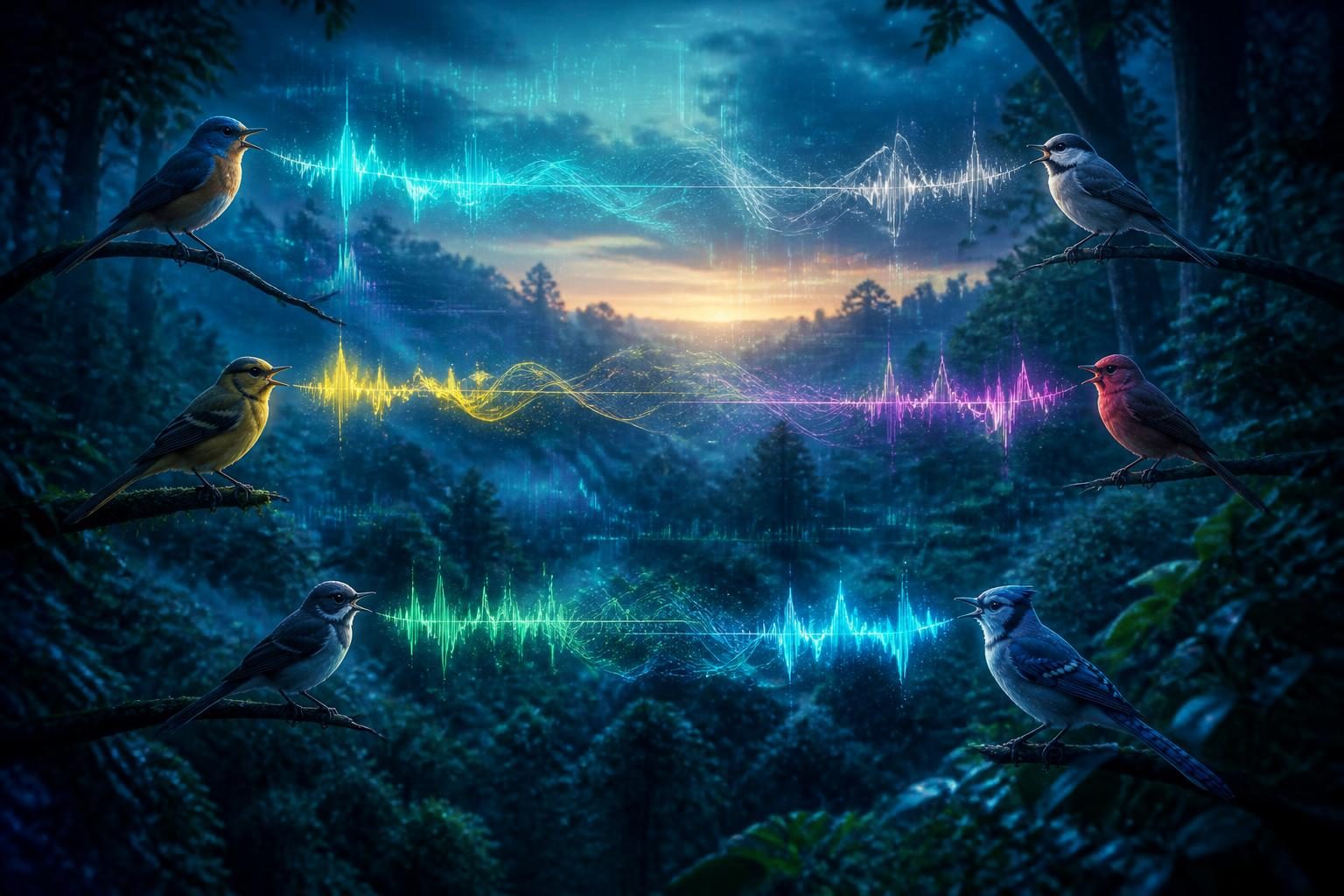
- Bird song dialects — many songbird species show regional "accents," learned from local tutors, with boundaries that can be mapped almost like human dialect regions.
- Population-specific call types — killer whale pods maintain distinctive call repertoires that persist across generations and differ between groups sharing the same waters.
The common thread: the differences aren't explained by genetics or environment alone. They're learned, and they're shared. That's the signature of tradition.
Why this is a bioacoustics problem, not just a biology one
Studying animal culture used to depend on painstaking manual work — a specialist transcribing songs by ear, comparing them phrase by phrase, tracking changes over years. It was slow, subjective, and limited to the handful of populations someone had the time to follow. Which meant most of the question stayed unasked.
Acoustic AI changes the scale of what's answerable. If a model can reliably segment and cluster the calls in a recording, you can begin to ask, systematically and across many populations at once:
- How similar are the repertoires of these two groups?
- Is this population's song drifting over time, and how fast?
- Did a novel call type appear here and then show up there — evidence of transmission?
- Do the boundaries between vocal traditions line up with social groups, geography, or neither?
These are cultural questions answered with acoustic tools. The model doesn't need to understand meaning to measure structure and change — and structure and change are exactly what cultural transmission leaves behind.
The overclaiming trap
Here's where honesty has to do real work, because this topic is a magnet for hype. Documenting that a song is socially learned and evolving is not the same as decoding what it means. We can show, rigorously, that humpback song is a cultural tradition. We cannot say what the song is about, or whether it's "about" anything in the sense we'd mean. Those are different claims requiring different, and much harder, evidence.
Similarly, "this population has its own dialect" is a strong, measurable statement. "These whales have a language" is not — it smuggles in assumptions about grammar, reference, and meaning that the acoustic data alone cannot support. The responsible path is to report what the sound structure shows and to clearly mark where measurement ends and interpretation begins.
This is exactly the line WAVE is built to respect. The tools can detect species, map repertoires, and compare structure across groups and time — the raw material of cultural analysis. What they don't do is leap from "this call recurs in this group" to "this call means X." That leap is where good science becomes bad headline, and the whole design philosophy is to hand researchers the measurements while refusing to fake the meaning.
What tradition implies for conservation
There's a practical, urgent reason to care beyond scientific curiosity. If a population's vocal repertoire is cultural — learned, shared, accumulated over generations — then it is also losable in a way genes are not. When a group's numbers crash, you don't just lose individuals and their DNA. You can lose knowledge: the specific song, the local dialect, the call types that took generations to develop and that no other group carries.
This reframes extinction. A dwindling population may be carrying an irreplaceable cultural repertoire toward silence. Protecting it means protecting not only a gene pool but a tradition — one that, once gone, cannot simply re-evolve. Acoustic monitoring becomes a way to track the health of a culture, not just a census of bodies.
Studying tradition without romanticizing it
The right posture is neither dismissive nor breathless. Dismissing whale song as "just instinct" ignores decades of evidence for social learning. Declaring that whales "have language and culture just like us" ignores how much those words carry that the evidence doesn't support. The interesting truth sits in between and is more remarkable for being real: some animals maintain learned, shared, evolving vocal traditions, and we now have tools to study them at a scale that was impossible a decade ago.
That's the spirit WAVE tries to bring to it — genuine wonder at what the data shows, matched by genuine discipline about what it doesn't. The songs are sweeping across the oceans. We're finally able to listen at the scale they deserve. What we should not do is pretend we already understand what they say.
How you actually measure a tradition
Claiming culture requires more than a compelling anecdote about a spreading song. It requires ruling out the alternatives. Could the difference between two groups be genetic? Test whether vocal similarity tracks relatedness — if unrelated animals in the same social group sound alike while relatives in different groups don't, learning beats genes. Could it be the environment? Check whether groups in identical habitats still differ. Could it be chance? Compare against what random drift would produce.
Only when genetics, environment, and chance are accounted for does social learning stand as the best explanation. That's a high bar, and it's the bar serious animal-culture research holds itself to. The reason acoustic AI matters here is that clearing the bar demands scale: many individuals, many groups, tracked over time, with repertoires compared consistently rather than by one expert's ear. Automated segmentation and clustering make that comparison feasible where it once wasn't.
The map of vocal traditions we could draw
Imagine the payoff of doing this systematically across a species' whole range: a map of vocal traditions, with boundaries where repertoires shift, arrows where novel call types spread from group to group, and a timeline showing how fast each tradition drifts. That map would be a cultural atlas — and it would have hard conservation value, flagging populations whose repertoires are unique and therefore irreplaceable.
We can't fully draw that map yet. The tools are still maturing, the archives are still filling, and the hardest populations are the least recorded. But the pieces are arriving. WAVE's role in that future is deliberately bounded and, we think, exactly right: provide the detection, comparison, and cross-referencing that turn scattered recordings into structured evidence — and leave the interpretation of meaning to the slow, careful science it demands. Measuring a tradition is achievable. Reading its mind is not, at least not yet, and a tool that pretends otherwise does the science a disservice.
A note on wonder, kept honest
There is a particular joy in this corner of the science, and it's worth protecting from both cynicism and hype. The joy is real: animals that learn songs from each other, change them over time, and pass novel variations across an ocean are doing something genuinely marvelous, and the evidence for it is solid. Protecting that joy means neither shrugging it off as mere instinct nor inflating it into claims of language and meaning the data can't bear. The honest position holds both truths at once — that these traditions are astonishing, and that we still don't know what the songs are about. Holding both is not a compromise; it's the whole discipline. It's what lets us stay amazed without fooling ourselves, which is the only kind of amazement worth building a science on.
Why it's worth getting right
Getting the culture question right is not academic hair-splitting. If some animal populations carry irreplaceable learned traditions, then protecting them means protecting knowledge, not just bodies — and losing them means a kind of loss that no captive-breeding program can undo. Measuring those traditions carefully, at scale, with tools honest about their limits, is how we even know what's at stake. That's reason enough to hold the science to its highest standard and to resist the easy headline in favor of the harder, truer story.