A finding that stops people in their tracks
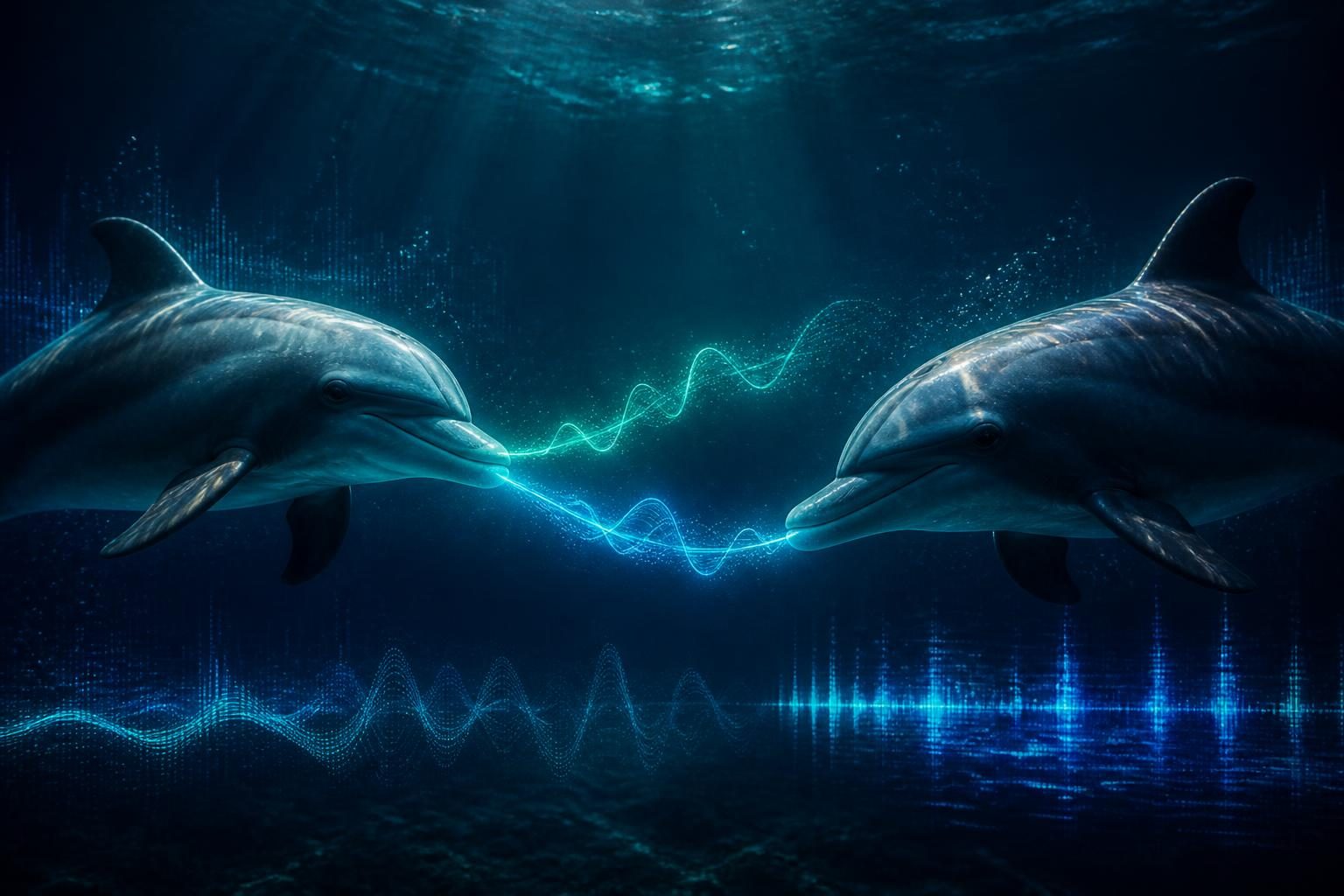
Of all the discoveries in animal communication, few grab people like this one: bottlenose dolphins appear to develop individually distinctive signature whistles — a unique whistle each dolphin produces, and that others can apparently recognize and even copy. Copy a dolphin's signature whistle back to it and it may respond, as if to its own name. Stated that way, it sounds like the door to animal language has cracked open. The truth is more careful, more contested, and — in its own way — more interesting than the headline.
Signature whistles are a superb case study in the central discipline of this whole field: how to stay genuinely excited about a remarkable finding while being rigorously honest about what it does and doesn't show.
What the evidence actually supports
The well-supported claims are striking enough on their own. Individual dolphins do appear to develop distinctive whistles early in life that remain recognizable over time. These whistles carry identity information — the acoustic equivalent of a consistent, individual signal. Dolphins can copy another individual's signature whistle, and there's evidence they use these whistles in contexts consistent with addressing or referring to specific individuals, such as maintaining contact when separated.
That's a lot, and none of it is trivial. Individual vocal identity — a signal that reliably says who is calling — is itself a significant cognitive and social capability. It implies the animals track one another as individuals, remember specific others, and produce and perceive fine acoustic distinctions. Similar individual-identity signals show up in other species too, from certain birds to some other social mammals. The phenomenon of "I can tell who's calling by the call" is real and widespread.
The leap that isn't justified — yet
Now the discipline. Calling a signature whistle a "name" imports a whole scaffolding of assumptions from human language: that the signal is an arbitrary label, referential, used intentionally to denote an individual the way a word denotes its meaning. Some of that may be true. Some of it is exactly what's still being investigated and debated. And some of it may be a human framework we're projecting onto a system that works differently.
The honest position holds several things at once:
- Individual identity in calls: well supported. The whistle reliably carries who-is-calling information.
- Recognition and copying: supported. Dolphins respond to and reproduce these whistles.
- "It's a name in the full human sense": an open, contested claim. Whether these function as arbitrary, referential labels used intentionally is precisely the hard question, not a settled fact.
This is not hedging for its own sake. It's the difference between what the acoustic and behavioral data demonstrate and what we'd like them to mean. Collapsing that difference is how a genuine, fascinating finding gets inflated into a false headline that ultimately damages the field's credibility.
Why individual identity matters for the tools
There's a practical thread here that connects to the technology directly. If individuals have distinctive vocal signatures, then acoustic monitoring can, in principle, track not just species but individuals — a capability with real conservation and research value. Knowing that a particular animal is present, or following one individual's movements and associations over time, is a powerful thing to be able to do non-invasively, from sound alone.
But it's also genuinely hard, and a good illustration of where automated analysis meets its limits. Distinguishing individuals by voice requires capturing fine acoustic detail, separating one animal's calls from overlapping others (the cocktail party problem again), and having enough reference material to learn each individual's signature. Confidence must be treated as evidence, not verdict — mistaking one individual for another is an easy error with real consequences for a study. The same honesty that governs species classification applies, with the bar raised: the finer the distinction you're claiming, the more scrutiny the claim deserves.
The mirror this holds up to us
Part of what makes signature whistles so compelling is that they force us to examine our own concepts. What is a name, exactly? A label that points to an individual? A signal others use to refer to that individual? Something used intentionally, with awareness of its function? When we ask whether a dolphin "has a name," we quickly discover that our own definition is fuzzier than we assumed — and that the animal's system might satisfy some parts of it and not others, or satisfy them in ways that don't map cleanly onto human language at all.
That's not a disappointment; it's the interesting part. The reality — animals with individually distinctive, recognizable, copyable vocal signals — is remarkable whether or not it fits the word "name." Insisting on the human label can actually obscure what's genuinely novel about the animal's system. Understanding the thing on its own terms is more valuable than forcing it into ours.
Excitement and honesty, together
Signature whistles are, in the end, a small masterclass in the posture this whole field requires. Dismiss them as "just individual variation" and you miss something profound about dolphin social cognition. Declare that "dolphins have names and language just like us" and you've raced past the evidence into a headline the data can't cash. The truth sits in between and is more remarkable for being real: some animals maintain individually distinctive vocal identities that others recognize and reproduce, and we now have tools sharp enough to study this at growing scale.
That posture — wonder disciplined by honesty — is exactly what WAVE tries to bring to every claim. Measure what's measurable. Mark clearly where measurement ends and interpretation begins. Stay excited about the genuinely astonishing thing in front of you without dressing it up as something it hasn't yet been shown to be. Whether or not a dolphin has a name, it can tell who's calling — and that, examined honestly, is wonder enough.
What it would take to know more
It's worth being concrete about how the open questions get closed, because "it's contested" can sound like a dead end when it's really a research program. Distinguishing a true name-like label from mere individual acoustic variation requires careful, cumulative evidence: showing that the signal is used to address or refer to a specific individual, that it's produced with something like intent, that receivers respond as if referred to, and that the association between signal and individual behaves like a learned label rather than an inevitable byproduct of that animal's anatomy. Each of those is a hard experiment, and each has to rule out simpler explanations before the stronger claim is earned.
This is exactly why acoustic tools matter to the question rather than settling it. Better detection, cleaner separation of overlapping calls, and larger, well-labeled reference sets let researchers gather the volume and precision of evidence these questions demand. The tools expand what's investigable; they don't shortcut the standard of proof. That division — powerful instruments, unchanged rigor — is the same one that runs through every honest claim in the field, and signature whistles are simply one of its most charming test cases.
The takeaway
Some animals can tell who is calling, and can copy and respond to individually distinctive signals — a genuine, well-supported, remarkable finding about social cognition and vocal identity. Whether that amounts to a "name" in the full human sense is an open, actively studied question, not a settled fact, and the honest move is to celebrate the first without smuggling in the second. Examined on its own terms, the phenomenon is wonder enough; forced into ours, it risks becoming a headline the evidence can't support. The right posture, here as everywhere in the field, is excitement disciplined by honesty.
Why the caution serves the wonder
It might seem that all the hedging drains the magic out of signature whistles, but the opposite is true. The caution is what protects the wonder from collapse. Overclaim — "dolphins have names and language like us" — and you set up an inevitable backlash when the fuller, messier truth emerges, and the genuine finding gets tarred as hype. State it precisely — animals with individually distinctive, recognizable, copyable vocal signals — and the wonder is durable, because it's true. Careful claims age well; inflated ones curdle. Choosing the careful version isn't timidity; it's how you make sure the astonishing real thing keeps its credibility long enough for people to keep studying it.
Beyond dolphins: identity signals across the tree of life
It's worth widening the lens, because individual vocal identity isn't a dolphin curiosity — it recurs across the animal world in different forms. Various birds can recognize mates, rivals, or offspring by voice; some colonial species pick out their own chick from thousands by call alone; several social mammals appear to track group members individually through sound. The specific mechanisms differ, and the strength of evidence varies by species, but the recurring theme is clear: for social animals that need to keep track of who is who, encoding individual identity in vocalizations is a broadly useful solution that evolution has arrived at many times.
That prevalence is part of why the topic matters beyond its charm. If identity is routinely encoded in calls, then acoustic monitoring has a latent capability to track individuals, not just species — opening research and conservation possibilities that were hard to imagine before. Realizing it responsibly demands the same discipline as everything else in the field: fine-grained capture, careful separation of overlapping calls, sufficient reference material, and confidence treated as evidence rather than verdict. The finer the claim — this individual, not just this species — the higher the bar of proof it must clear.