Borrowing the biggest idea in AI
The last few years of artificial intelligence have been dominated by a single structural idea: the foundation model. Instead of training a narrow model for one narrow task, you train an enormous model on a vast, broad dataset until it learns general-purpose representations — and then adapt that one model to many specific tasks with relatively little extra effort. Large language models are the famous example. The same idea is now arriving in bioacoustics, and it may be the most important shift the field has seen.
Two names anchor the conversation: Perch, from Google's bioacoustics research, and NatureLM-audio, from the Earth Species Project. They represent different flavors of the same bet — that a model trained broadly enough on natural sound can generalize in ways narrow classifiers never could. It's worth understanding what that bet actually is, because it's easy to mistake for something it isn't.
What a foundation model for sound learns
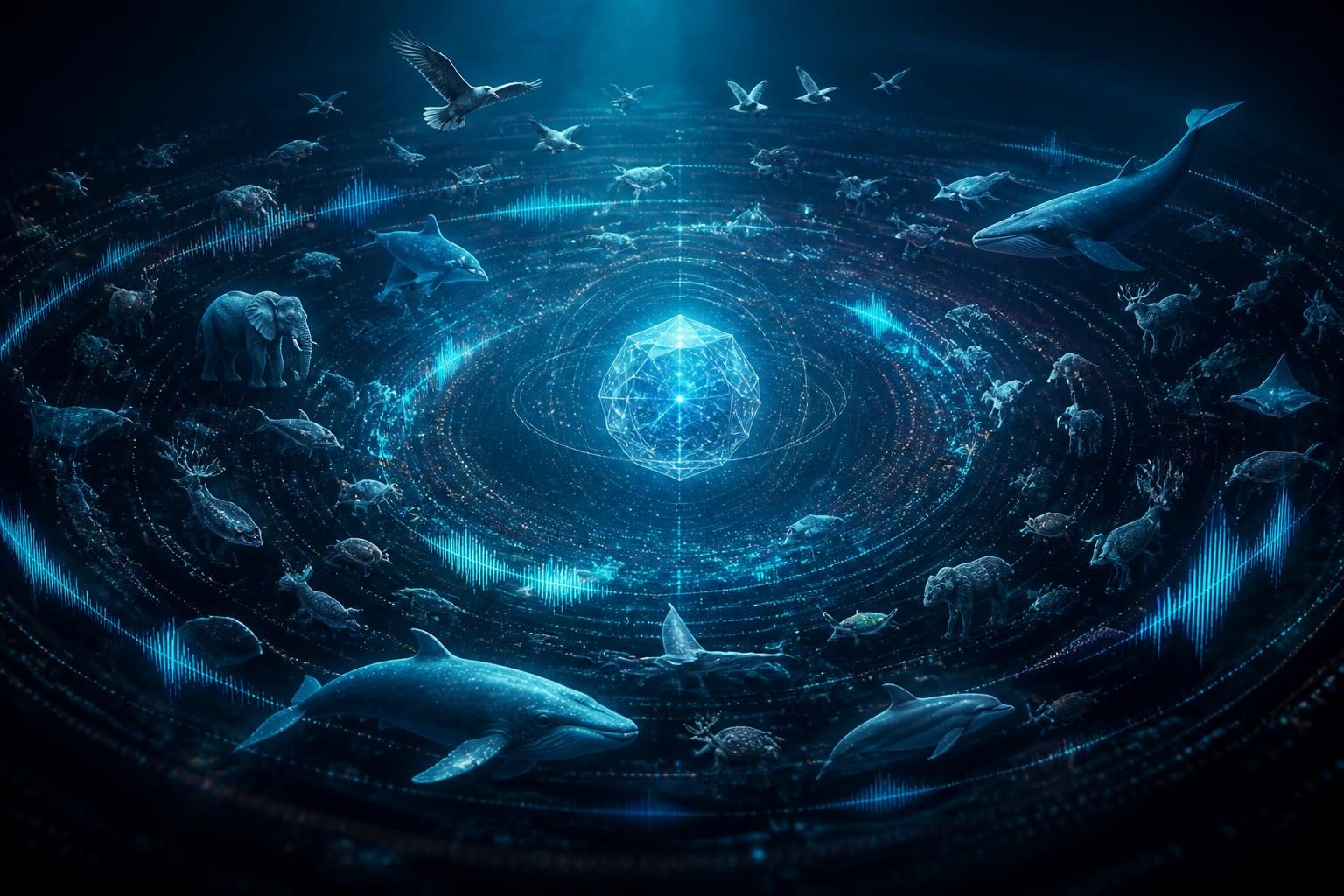
A traditional species classifier learns a fixed question: given this audio, which of my known species is it? A foundation model aims lower and higher at once. Lower, because it may not start by naming species at all — it learns to produce rich embeddings, compact numerical fingerprints that capture the essential structure of a sound. Higher, because those embeddings turn out to be broadly useful: two sounds that are biologically similar end up with similar fingerprints, even for species the model never explicitly learned to name.
This unlocks something genuinely new. With good embeddings, you can:
- Cluster a pile of unlabeled recordings into natural groups — a first draft of a vocal repertoire, with no labels required.
- Search by similarity — "find me other sounds like this one" across a huge archive.
- Do few-shot learning — teach the model a brand-new species or call type from a handful of examples, by training a tiny classifier on top of the frozen embeddings rather than retraining the whole giant.
That last capability is the quiet revolution. The perennial curse of bioacoustics is scarce labeled data for most species. If a foundation model can be adapted to a new species from five clean examples instead of five thousand, the long tail of under-studied animals suddenly comes within reach.
The surprising result: bird training transfers to whales
Here's the finding that made researchers sit up. Perch was trained overwhelmingly on birds — that's where the data is. And yet its embeddings proved useful for tasks it was never trained on, including marine mammal and other underwater audio, via that few-shot transfer approach. A model that had heard almost no whales still produced representations that helped organize whale sound.
Why would that happen? The leading intuition is that the low-level structure of animal vocalization — how energy is organized across time and frequency, how calls repeat and vary — shares deep regularities across very different species. Learn those regularities richly enough from birds, and you've learned something that partly applies to animals in general. It's the acoustic echo of the same principle that lets a language model trained mostly on English pick up patterns useful in other languages.
This is the technical foundation beneath WAVE's honest roadmap. WAVE's live bird identification runs on BirdNET, which is excellent and birds-first. The path to genuine multi-taxa prediction — whales, mammals, amphibians — runs through exactly this kind of foundation model, adapted via embeddings and few-shot heads. It's wired into WAVE's pipeline as a slot ready to activate, precisely because this is the credible route from "birds work" to "everything works."
Where the hype outruns the science
Now the candor, because foundation models attract breathless claims. A few things they are not:
- They are not translators. A rich embedding of a whale call captures its structure, not its meaning. "The model understands whale" is a category error. It understands similarity and pattern, which is powerful and different.
- They are not free of their data's biases. "Trained broadly" still means trained on what exists, and what exists is skewed toward birds and a handful of well-studied species. The long tail is still thin. Transfer helps; it doesn't conjure knowledge from nothing.
- They are not automatically reliable out of the box. Few-shot adaptation still needs good examples and careful evaluation. A model adapted from five noisy, mislabeled clips will confidently produce nonsense.
- They are not a reason to remove the human. If anything, the ability to surface structure in unlabeled audio makes expert judgment more valuable, not less — someone has to decide what the clusters mean.
The responsible framing is that foundation models dramatically expand what's possible to attempt, while leaving the standards of evidence exactly where they were. They are a bigger telescope, not a shortcut past the science.
What changes for researchers, concretely
If you run a bioacoustics program, foundation models shift the practical calculus in real ways:
- Unlabeled data becomes an asset, not a burden. Those terabytes you never had time to label can be clustered and explored for structure immediately.
- New species become approachable fast. A handful of confirmed recordings can bootstrap a workable detector for an animal that had no dedicated model before.
- Cross-archive similarity search becomes feasible. Ask "what else sounds like this?" across the whole documented world of animal sound.
WAVE's design leans into all three: connect the validated archives, prepare the embedding-based multi-taxa slot, and keep the researcher in the loop to interpret what the model surfaces. The tool's job is to make the foundation model's power usable and honest, not to dress it up as a mind that speaks whale.
The genuine promise, stated plainly
Strip away the hype and a real, exciting promise remains. For the first time, we have models that learn general structure from natural sound and transfer it across species — including to animals they barely trained on. That is a legitimate leap toward monitoring the whole acoustic living world, not just its best-studied corners, and toward mapping vocal repertoires at a scale that manual work could never touch.
What it is not is a Rosetta Stone. It's a vastly better listening and organizing engine, and the difference matters. Used with the discipline the science demands — good examples, honest evaluation, human interpretation, clear limits — foundation models could do for the rest of the animal kingdom what BirdNET did for birds. That's the future WAVE is building toward: not a machine that translates nature, but one that helps us finally listen to all of it at once.
Embeddings, explained without the jargon
The word embedding does a lot of work in this story, so it's worth demystifying. Think of an embedding as a set of coordinates for a sound in a very high-dimensional "map of all sounds." Two calls that are biologically alike land near each other on the map; two that are very different land far apart. The model's whole skill is learning to place sounds on that map sensibly.
Once you have a good map, an astonishing amount becomes easy. Classification is just asking "which labeled region is this point in?" Similarity search is "what other points are nearby?" Clustering is "where do the points naturally clump?" Few-shot learning is "draw a small boundary around these five example points and call it a new species." The heavy lifting — learning the map — happens once, on vast data. Everything downstream reuses it cheaply. That reuse is the entire economic and scientific advantage of the foundation-model approach.
The data gap that transfer can soften but not erase
It's tempting to hear "bird training transfers to whales" and conclude the data problem is solved. It isn't. Transfer softens the scarcity of labeled data; it doesn't eliminate it. To adapt a foundation model to a new species you still need clean, correctly labeled examples — just far fewer of them. And "far fewer" is only useful if those few are good. Five mislabeled or noise-choked clips will teach the model something confidently wrong.
So the archives still matter enormously, and contributing to them still matters. The difference is one of leverage: in the old world, a rare species needed thousands of recordings before a usable detector was possible, which for many animals meant never. In the foundation-model world, a dedicated researcher with a handful of confirmed recordings can bootstrap something workable. That lowers the barrier from "impossible" to "hard but doable" for a huge swath of the animal kingdom — which is exactly why it's worth being excited and precise about.
The right kind of excitement
It's worth ending on the distinction that separates useful enthusiasm from hype. The exciting, defensible claim is that foundation models let us listen and organize natural sound at a generality and scale we've never had — clustering the unlabeled, bootstrapping detectors for the barely-recorded, searching similarity across the whole documented world of animal voices. The unsupportable claim is that they understand what animals mean. The first is a revolution in reach; the second is a category error dressed as a breakthrough. Keeping them separate is not pedantry — it's what lets the field spend its credibility wisely, on progress that will still look real in ten years. That's the kind of excitement WAVE is built to carry forward: big ambitions about listening, matched by strict honesty about meaning.