The oldest survey method has a blind spot
For a century, wildlife surveys meant people: transect walks, point counts, boat-based observers with binoculars. It works, but it has a stubborn limitation — animals are mostly hidden, mostly nocturnal or cryptic, and mostly somewhere a human isn't standing at the moment they do something interesting. A dawn bird count captures a slice of one morning. A whale survey captures the animals that happen to surface near the ship. Everything else is invisible.
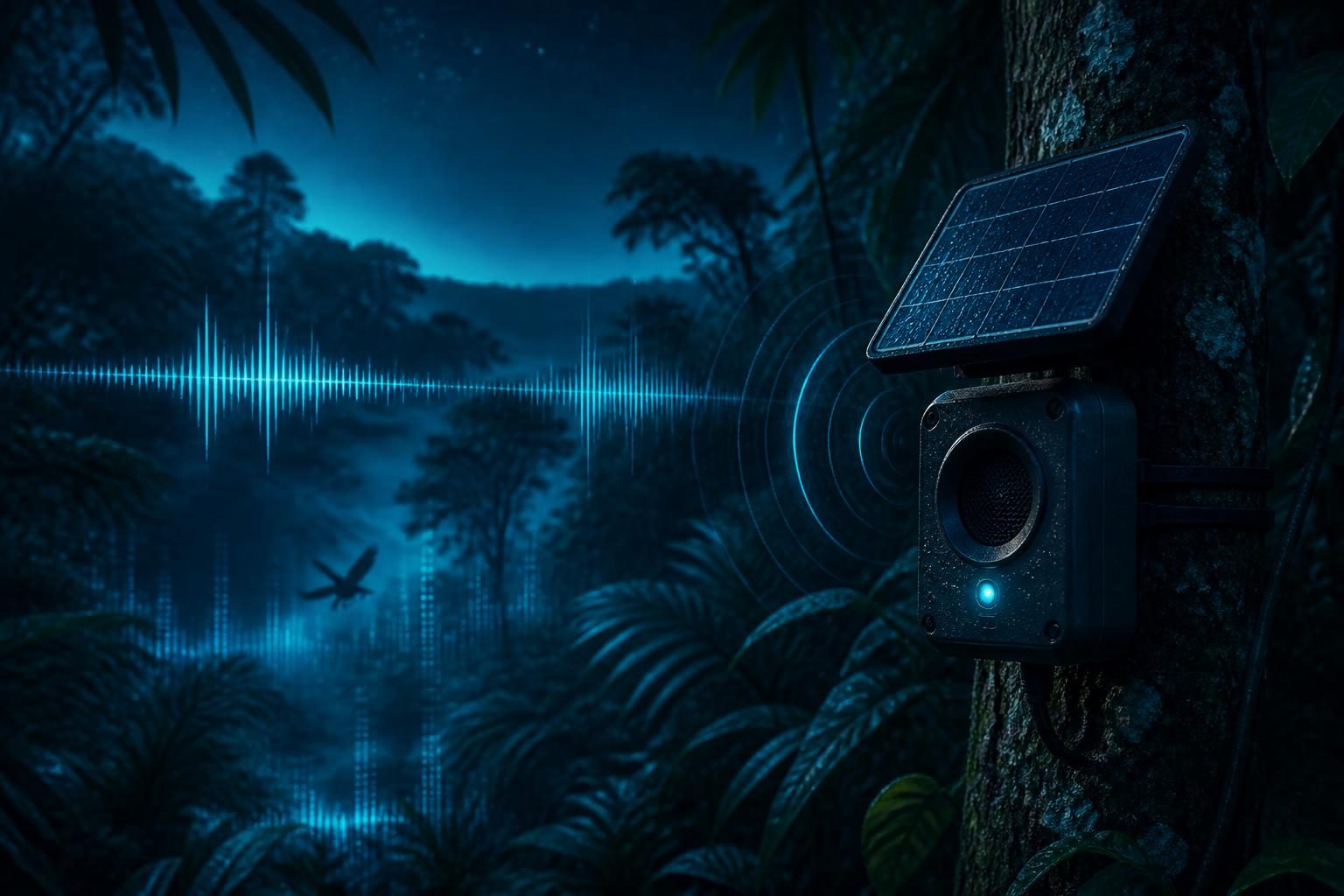
Passive acoustic monitoring (PAM) attacks the blind spot directly. Instead of sending observers, you deploy recorders — microphones on land, hydrophones in water — and let them listen continuously, for weeks or months, whether or not anyone is there. The animals announce themselves. The recorder never blinks, never gets cold, never scares the subject away.
Why "passive" is the whole point
The word matters. Active acoustic methods (like sonar) emit sound and listen for echoes. Passive methods emit nothing — they only listen. That distinction has real consequences:
- No disturbance. You are not adding energy to the environment, which matters enormously for noise-sensitive marine mammals.
- No observer effect. Animals behave as if no one is watching, because no one is.
- Round-the-clock coverage. Nocturnal species, deep-diving whales, and secretive mammals get counted at the times they're actually active.
The trade is that you get an enormous pile of audio and no one to interpret it in real time. That pile is exactly where the last decade's revolution happened.
The data deluge that changed everything
A single continuous recorder can generate terabytes of audio over a season. Multiply by a network of sensors across a landscape or a coastline, and you have a volume of sound that no team of human listeners could ever review. For years this was PAM's dirty secret: the recording was easy, the analysis was the bottleneck. Recordings sat on hard drives, partially reviewed, because listening to them all was physically impossible.
Machine learning broke the bottleneck. Detection and classification models can now sweep through months of audio and surface the moments that matter — the calls, the songs, the species — flagging them for human confirmation. What took a specialist a full field season can take a model an afternoon. The recorder captures everything; the model triages it; the human validates the interesting fraction.
This is the workflow WAVE is built around. The classifier does the first pass at scale; the confidence scores tell you where to look; the reference databases let you confirm. The human stays in the loop where judgment is needed and stays out of the loop where brute-force listening was just wasting expertise.
What PAM can measure that eyes can't
Done well, acoustic monitoring yields far more than a species checklist:
- Presence and absence over time. When did the first spring migrant arrive? When did the whales leave the feeding ground? Continuous audio gives you dates, not guesses.
- Diel and seasonal patterns. Dawn choruses, nocturnal activity, breeding-season song — all fall out of the timeline naturally.
- Relative abundance and activity. Call rates can index how much a species is using an area, even when counting individuals is impossible.
- Soundscape health. The overall acoustic character of a habitat — how full, how varied, how disrupted by noise — is itself a signal of ecosystem condition.
That last point has grown into its own discipline: soundscape ecology, which treats the collective sound of a place as a measurable property of the ecosystem, not just a backdrop.
The honest limits
PAM is powerful, not omniscient, and pretending otherwise leads to bad science:
- You detect sound-makers, not silent species. A snake, a lizard, most fish outside spawning aggregations — acoustically invisible. Absence of sound is not absence of the animal.
- Detection range is not uniform. A loud, low-frequency whale call travels for kilometers; a quiet insect carries a few meters. Comparing "how much" across species without accounting for detectability is a trap.
- Counting individuals from calls is hard. Ten calls could be one chatty animal or ten quiet ones. Robust abundance estimates need careful modeling, not raw counts.
- Noise contaminates. Wind, rain, ships, traffic, and the recorder's own electronics all intrude. Some of your "detections" will be artifacts, which is exactly why confidence scores and human confirmation exist.
WAVE's whole framing is built to respect these limits rather than paper over them. A confidence bar is not a verdict; a species prediction points you to reference recordings so you can check; and the tool never claims a silence means an empty forest.
From single sensor to living network
The frontier now is scale and integration. A lone recorder tells you about one spot. A network of recorders, timestamped and georeferenced, lets you watch a species move across a landscape or a season — a migration front sweeping north, a whale population shifting with its prey. Add environmental data (temperature, depth, moon phase, ship traffic) and acoustic detections become part of a much richer picture of why animals are where they are, when they are.
This is where connecting archives pays off. A detection on a hydrophone becomes far more meaningful when you can cross-reference it against reference recordings in the Watkins Marine Mammal Sound Database, ground it in occurrence records from GBIF, or compare it with community recordings on iNaturalist. The single sensor becomes a query into the whole documented world of that species.
Why this is the quiet revolution
There's no dramatic gadget here — just microphones that don't quit and models that don't tire. But the effect is profound: we can now monitor wildlife continuously, non-invasively, at a scale and resolution that direct observation could never reach, in places no observer could stay. For endangered species, for remote habitats, for the deep ocean, PAM is often the only practical way to know what's there and how it's changing.
The recorder listens. The model triages. The human decides. That loop, run at planetary scale, is quietly rewriting what it's possible to know about the living world — and it does it without the animals ever knowing they were counted.
The economics that make it irresistible
Consider the arithmetic a conservation manager faces. A team of skilled field observers is expensive, finite, and can cover a limited area for a limited time. A recorder costs a fraction of a salary, works every hour of every day, and can be duplicated across dozens of sites. When the analysis bottleneck was human listening, that math didn't fully pay off — you saved on fieldwork and spent it on review. Now that models handle the first pass, the savings compound. The same budget buys an order of magnitude more coverage.
This is why PAM has spread fastest exactly where budgets are tightest and access is hardest: remote tropical forests, polar seas, marine protected areas far from any port. The method scales to places and durations that direct observation simply cannot afford.
Case in point: monitoring an endangered voice
Take a critically endangered whale population whose numbers are too low and range too vast for reliable visual survey. Ship time is scarce and weather-dependent; the animals dive deep and surface briefly. Visual surveys might log a handful of sightings in a season. A moored hydrophone, by contrast, can register the population's calls whenever they pass within range — day or night, storm or calm — building a continuous record of presence, seasonality, and habitat use that no observer schedule could match.
The same logic extends on land: a network of recorders can confirm whether a rare, secretive bird still occupies a forest patch by catching a single diagnostic call across weeks of listening, where a one-morning survey would likely have missed it entirely and wrongly concluded "gone."
Building trust in the numbers
Because PAM produces detections rather than sightings, turning it into rigorous science requires a few disciplines:
- Calibrate detectability. Model how far each call type carries under local conditions so you don't mistake a loud species for an abundant one.
- Ground-truth the model. Have experts confirm a sample of detections to measure the false-positive and false-negative rates. A detector without a known error rate is a rumor, not a result.
- Pair audio with metadata. Timestamps, locations, depth, temperature, and human-noise levels turn raw detections into ecological insight.
- Archive everything. The recordings outlive the study. A clip analyzed today with a bird-first model can be re-analyzed tomorrow with a broad-taxa one, extracting new findings from old data.
That last discipline is quietly one of PAM's greatest gifts: the raw sound is a permanent asset. As models improve, the archive keeps yielding more, without a single new field day.
The quiet promise, restated
The deepest gift of passive acoustic monitoring is that it lets us watch over the living world without intruding on it — continuously, affordably, in places no observer could stay. Recorders that never blink, models that never tire, and humans who step in exactly where judgment is needed: that loop, run at scale, is how we finally keep a continuous ear on species and habitats that used to slip through the gaps between surveys. It won't hear the silent species, and it won't count without care. But for the vast, noisy, sound-making majority of life, it may be the best listening post conservation has ever built.