From the single voice to the whole choir
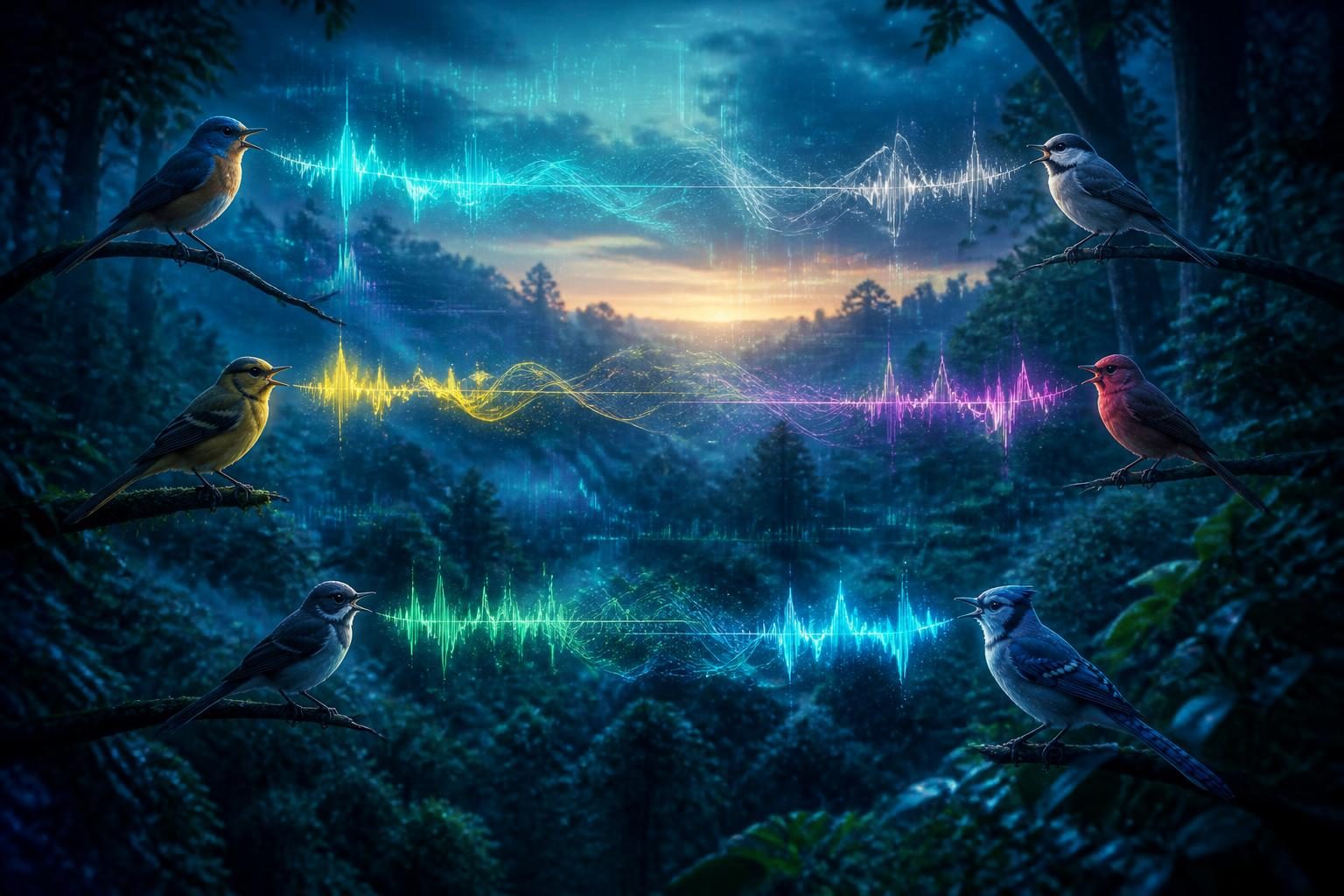
Most of bioacoustics, and most of this blog, focuses on the individual voice: detect a species, identify a call, map a repertoire. But there's a complementary way to listen that steps back from any single animal and takes in the entire acoustic scene at once. It's called soundscape ecology, and its central insight is deceptively simple: the collective sound of a place is itself a measurable property of that ecosystem — one that carries real information about its health.
A thriving habitat sounds different from a degraded one. Not just "more birds," but a fuller, more structured, more temporally organized wall of sound. Soundscape ecology takes that intuition and makes it rigorous, turning the ambient roar of a forest or reef into data.
The three sources of a soundscape
Researchers find it useful to decompose any soundscape into three contributors:
- Biophony — the sounds of living things: birds, insects, frogs, mammals, fish. This is the biological signal, the chorus of the community.
- Geophony — the sounds of the non-living environment: wind, rain, thunder, waves, flowing water, cracking ice. The planet's own voice.
- Anthrophony — the sounds of human activity: traffic, aircraft, machinery, shipping, construction. The intrusion.
The relationships among these three tell a story. A healthy natural area is rich in biophony, shaped by geophony, and largely free of anthrophony. As human noise rises, it can literally mask the biophony — drowning out the animals' ability to hear and be heard — and the balance shifts in ways you can quantify.
Reading a soundscape without naming every animal
The elegant part is that you don't have to identify every species to learn something. Soundscape ecologists compute acoustic indices — summary numbers that capture properties of the whole recording:
- Diversity of sound — how many distinct frequency bands and patterns are active, a rough proxy for how many different sound-makers are present.
- Acoustic complexity — how much the sound varies and structures over time, versus flat, monotonous noise.
- Temporal patterning — the daily rhythms: dawn choruses, dusk swells, nocturnal shifts, all of which reflect a functioning community.
- The biophony-to-anthrophony balance — how much of the soundscape is life versus human intrusion.
These indices let you track a habitat's condition over time, or compare two habitats, without the enormous labor of identifying every caller. A dawn chorus that thins year over year, a reef that falls quiet, a forest where anthrophony creeps up the indices — these are early warnings, audible before many other signs of decline appear.
The reef that fell silent — and the one that sang back
Coral reefs make the point vividly. A healthy reef is astonishingly loud up close: a crackling, popping, chorusing soundscape produced by snapping shrimp, fish, and countless invertebrates. That sound isn't just a byproduct — it's a cue. Larval fish and coral drifting in the open ocean use reef sound to find their way home to suitable habitat.
When a reef degrades, it quiets. And that silence becomes self-reinforcing: a quiet reef attracts fewer settling larvae, which slows recovery. Researchers have even experimented with acoustic enrichment — playing healthy-reef sounds at degraded sites to lure life back. Whether or not that scales, the underlying science is clear: the reef's soundscape is both an indicator of its health and an active ingredient in its recovery. Listening to the whole chorus tells you things that counting individual fish never would.
Why AI makes soundscape ecology finally practical
Acoustic indices are computable by hand, in principle. In practice, soundscape ecology drowns in the same data deluge as the rest of passive monitoring — months of continuous audio across many sites. The discipline needed automation to reach its potential, and it's getting it. Models can compute indices at scale, detect the emergence or disappearance of particular sound sources, flag anomalies, and track long-term trends across sensor networks.
Crucially, the single-species and whole-soundscape approaches reinforce each other. Species-level identification tells you who is contributing to the biophony; soundscape indices tell you about the health of the whole. WAVE's toolkit — species detection, cross-referencing to validated archives, high-resolution analysis — feeds both views. You can zoom in to name a caller and zoom out to read the chorus, and the two together are far more informative than either alone.
The honest caveats
Soundscape ecology is powerful but not a magic gauge, and it has real limits worth stating:
- Indices are proxies, not truths. A high diversity index suggests a rich community, but noise, weather, and recording conditions all influence it. Indices must be interpreted, not read off like a thermometer.
- Silent contributors are still invisible. A habitat's health includes organisms that make no sound; the soundscape sees only the acoustically active fraction.
- Comparisons need care. Different habitats have naturally different soundscapes; a desert is not a rainforest, and neither failure nor health looks the same across biomes.
- Human noise complicates everything. Anthrophony doesn't just add to the soundscape; it can mask and distort the biophony you're trying to measure, so accounting for it is part of the analysis, not a nuisance to ignore.
As always, the responsible stance is to treat acoustic indices as strong evidence to be corroborated, not verdicts to be trusted blindly — the same discipline that applies to any single species prediction.
Listening to the whole living world
There's something fitting about soundscape ecology as a frame for everything WAVE is trying to do. The individual voice matters — the whale, the bird, the frog — but each one lives inside a chorus, and the chorus itself is alive with meaning. Learning to read that chorus, at scale, by ear and by algorithm, gives conservation an early-warning system for the health of entire habitats.
The forest, the reef, the open ocean — each has a voice that is more than the sum of its animals. When it thins, when it quiets, when human noise crowds it out, the soundscape tells us before most other signs do. Our job is to listen well enough to hear the warning in time.
A dashboard for a living system
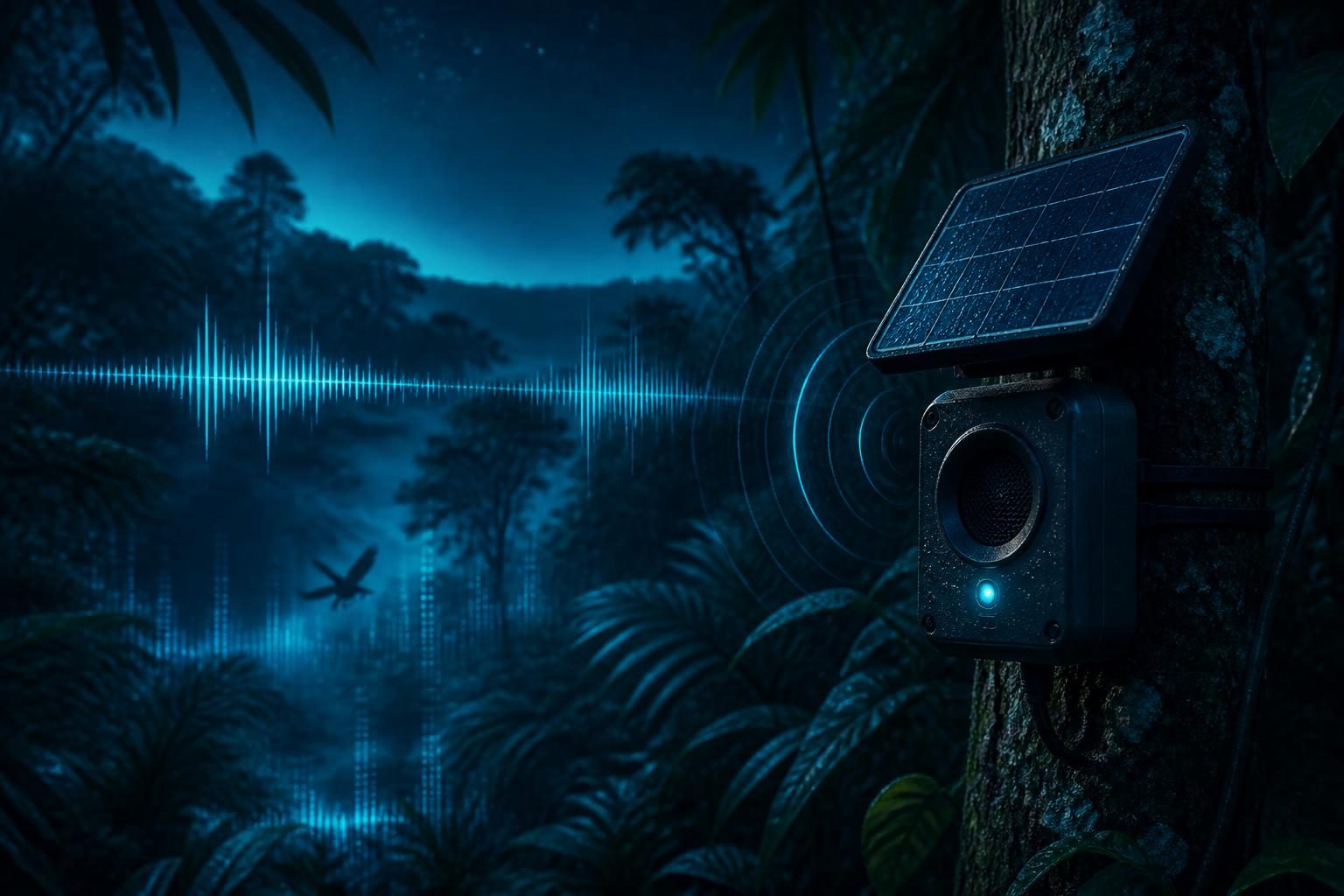
It helps to picture where this leads. Imagine a conservation team with a network of recorders across a protected area, and a dashboard that turns the incoming audio into a few living gauges: biophony trending up or down, anthrophony creeping in from a new road, the dawn chorus arriving earlier or later with the shifting season, an anomaly flag when a familiar sound source goes quiet. None of those gauges requires naming every animal. Together they function as vital signs for the ecosystem — a continuous readout of its health that no periodic survey could match.
That's the promise of soundscape ecology married to automation: not a snapshot but a monitor, always on, sensitive to change, and cheap enough to run at the scale of whole landscapes and coastlines. When something starts to go wrong, the soundscape often registers it first — and an always-listening system can catch that early warning while there's still time to act.
Zooming in and out on the same data
The quiet elegance is that the same recordings serve both scales of analysis. Run species detection over them and you learn who is present and how their activity shifts. Compute acoustic indices over them and you learn about the health of the whole community. One archive, two complementary lenses. A researcher can move fluidly from "the reef fell quiet in March" (the soundscape view) to "and here's the specific chorus of fish and shrimp that disappeared" (the species view) — a chain of reasoning that turns an ambient trend into an actionable, checkable finding.
WAVE's toolkit is built to support exactly that movement between scales, and to keep it honest at both: indices treated as proxies to corroborate, species predictions treated as evidence to confirm, and the human always able to look at the underlying sound. The chorus and the voice, read together, with the same discipline applied to each.
The chorus as an early-warning system
The most practical reason to care about whole-soundscape listening is timing. Many signs of ecosystem decline show up late, after damage is well underway. The soundscape often shifts earlier — a chorus that thins, a reef that quiets, human noise that creeps up the indices — giving conservation a chance to notice and respond before a slow loss becomes an irreversible one. An always-on acoustic monitor is, in effect, a stethoscope pressed to a habitat's chest, reporting its vital signs continuously. Learning to read those signs, at the scale of whole landscapes and coastlines, may prove to be one of the most valuable things bioacoustics ever offers conservation — not because it names every animal, but because it hears the whole system breathing, and notices when the breathing changes.
In one breath
Stop straining to name a single caller and listen, for a moment, to the whole chorus. Its fullness, its rhythm, its balance of life against noise — all of it is data, and much of it warns you of trouble before anything else does. Learning to read a habitat by ear, at scale, is how we turn ambient sound into an early-warning system for the living world.