Translation is a data problem before it's an AI problem
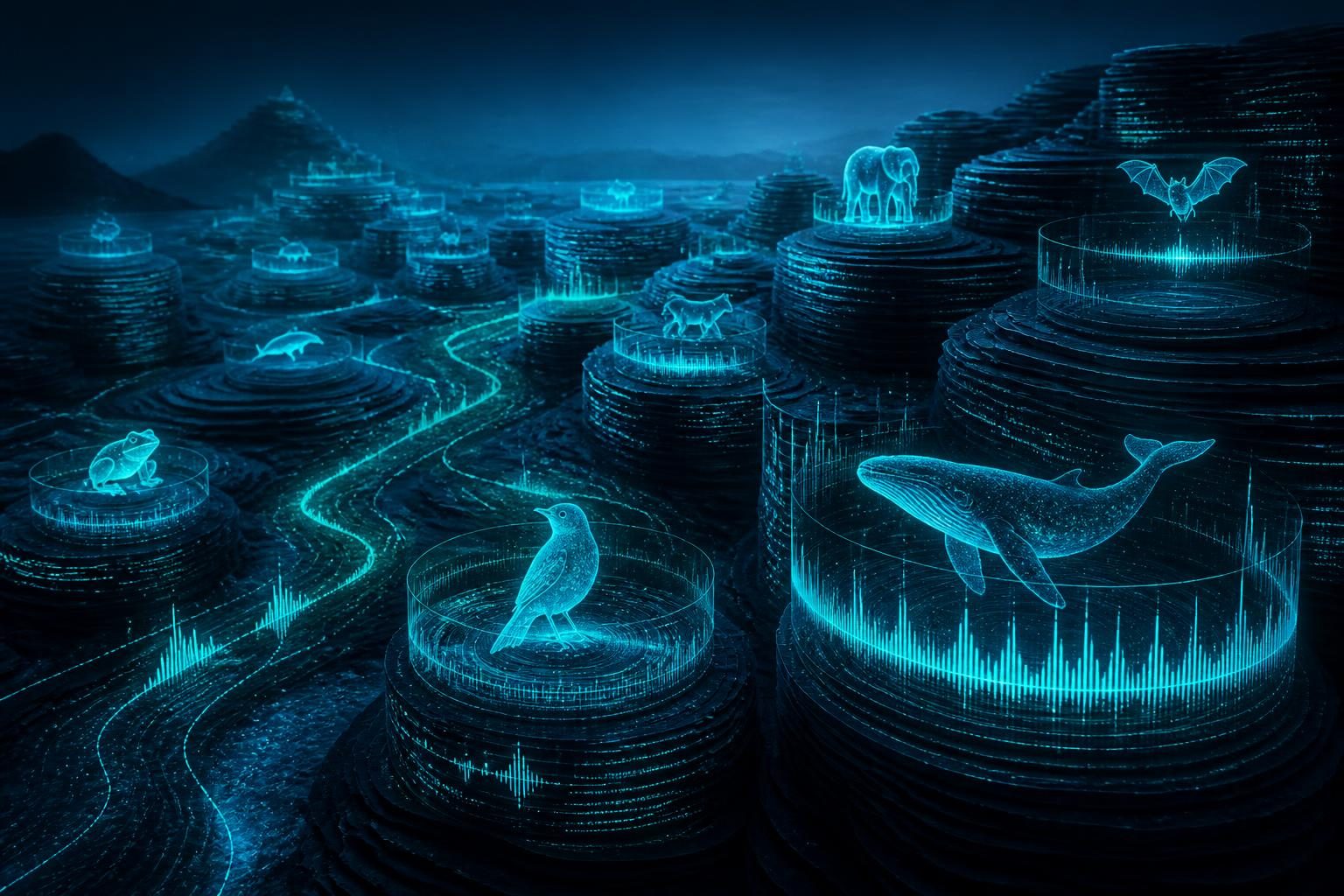
You cannot decode a species from a handful of clips. Progress in animal communication comes from breadth — many species, many contexts, cross-referenced. That's why WAVE is built to connect the field's foundational sources rather than rely on one.
The archives
- Macaulay Library (Cornell) — the world's largest animal media archive, 3.2M+ audio recordings covering ~96% of bird species.
- Xeno-canto — 800k+ community-contributed wildlife recordings, with a public API.
- Watkins Marine Mammal Sound Database (WHOI) — freely downloadable marine mammal calls across 60+ species.
- Animal Sound Archive (Museum für Naturkunde Berlin) — 120k+ recordings, the third-largest bioacoustic collection worldwide.
- iNaturalist Sounds — 230k+ citizen-science audio files across 5,500+ species, with an open API.
The AI-native projects
- Earth Species Project — NatureLM-audio and the BEANS benchmark; open datasets built for machine learning.
- Project CETI — a large-scale sperm whale acoustic and behavioral corpus aimed squarely at decoding communication.
- Perch (Google) — pretrained bioacoustic models and embeddings, validated on BirdSet and BEANS.
- GBIF — billions of species-occurrence records that ground acoustic findings in where animals actually are.
Why WAVE connects rather than replaces
Each source is strong at something and silent elsewhere. Macaulay has unmatched bird depth; Watkins owns marine mammals; CETI goes deep on one species. WAVE's job is to make them searchable together — you can already search live across iNaturalist and GBIF from the Resources page — so a researcher works across the whole landscape instead of one silo. That's what turns scattered archives into a translation resource.