Everything starts at the sensor
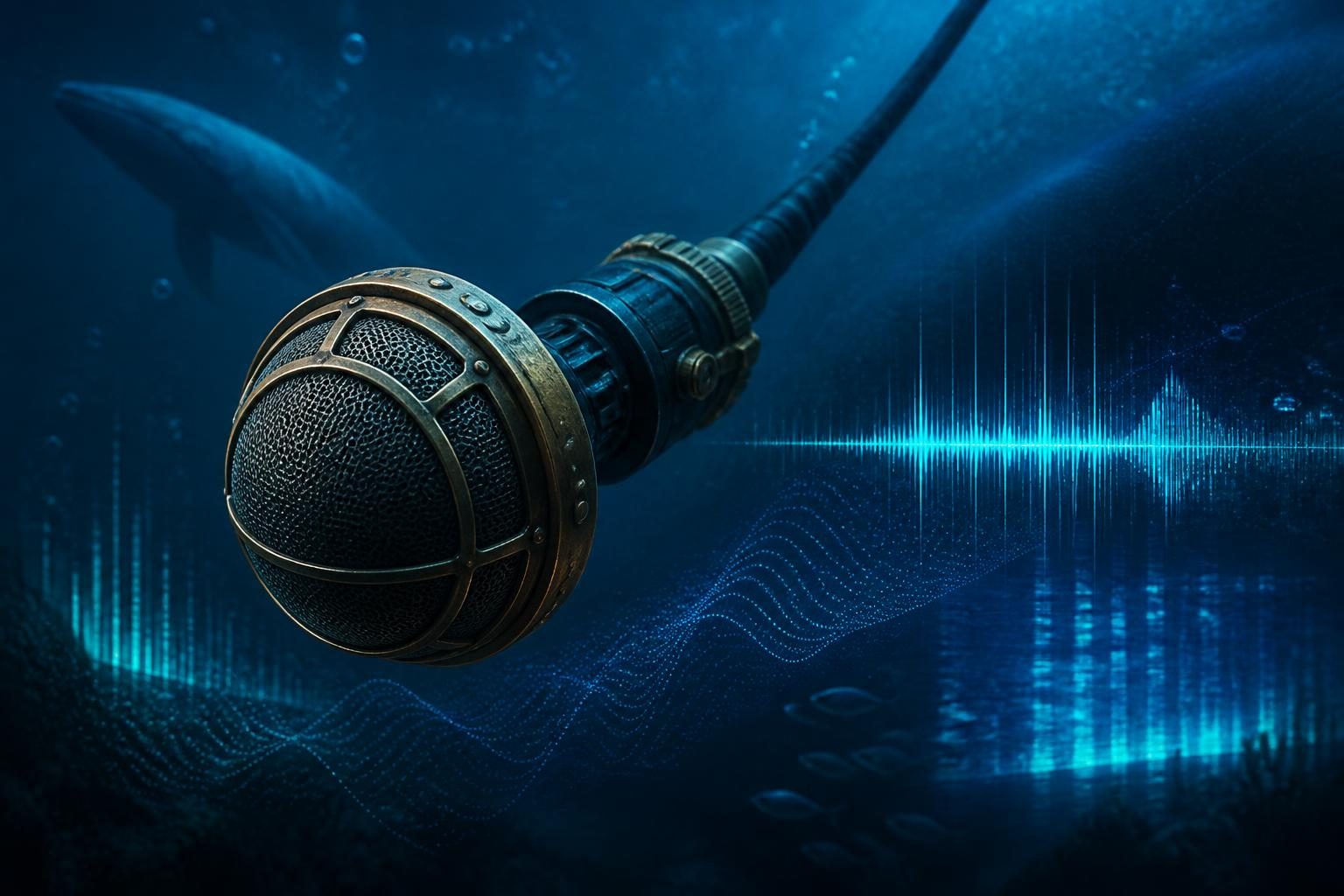
It's easy to get swept up in models, embeddings, and spectrograms and forget that none of it exists without a first, physical step: something has to convert a pressure wave in water into an electrical signal a computer can store. Underwater, that something is a hydrophone — a microphone built for the sea. It is the least glamorous component in all of marine bioacoustics and arguably the most consequential, because every downstream analysis inherits its strengths, its limits, and its distortions. Misunderstand your sensor and you'll misread everything it captures.
Why water changes everything
Air microphones and hydrophones share a basic idea — a transducer that turns pressure changes into voltage — but the medium changes the engineering profoundly. Water is roughly eight hundred times denser than air, and sound travels through it far faster and typically farther. A hydrophone has to be acoustically matched to that dense medium, sealed against pressure that increases relentlessly with depth, and rugged enough to survive months in a corrosive, cold, high-pressure environment where no one can service it.
These constraints aren't trivia; they're the reason marine recordings look the way they do. The sensor's frequency response — which frequencies it captures faithfully and which it rolls off — determines what parts of an animal's voice even make it into the recording. Its sensitivity sets how faint a call it can detect above the electrical noise it generates itself. Its depth rating decides where you can deploy it. Every one of these specs quietly bounds the science.
The self-noise floor: your sensor is never silent
A crucial and under-appreciated fact: a hydrophone is never perfectly quiet. It generates its own small amount of electrical noise, the self-noise floor, and anything quieter than that floor is simply invisible — not attenuated, not faint, but absent from the data entirely. A distant whale call that falls below the floor didn't fail to happen; it failed to be recorded, and no amount of clever analysis can recover what was never captured.
This is why "we detected no calls" is such a treacherous statement in marine work. It might mean the animals were silent. It might mean they were present but distant, their calls swallowed by the noise floor. It might mean the sensor's response de-emphasized their frequency band. Absence of detection is not detection of absence — a principle that runs through all passive monitoring but bites especially hard underwater, where detection ranges vary enormously with conditions and the sensor's own limits are always in play.
Placement is half the experiment
A hydrophone's data is only as good as where you put it. Depth matters because sound in the ocean bends through layers of differing temperature and pressure, creating channels that carry some sounds far and shadow others. Proximity to noise sources — shipping lanes, surf, ice — can drown the biology you're after. Anchoring and mounting affect how much the sensor picks up its own movement and cable noise. Two hydrophones of identical spec, placed differently, can tell very different stories about the same patch of ocean.
Deploy several in an array, and something new becomes possible: by comparing when a sound reaches each sensor, you can estimate the direction and even the location of its source, and steer the array's sensitivity toward one direction while rejecting others. This is how the field partially attacks the underwater cocktail party problem — with geometry. But it multiplies the engineering and the data, and it demands careful synchronization. The single sensor tells you what and when; the array begins to tell you where.
What the sensor's quirks mean for analysis
Because everything downstream inherits the hydrophone's character, responsible analysis keeps the sensor in mind at every step:
- Know the frequency response. A call that looks weak might be a strong call in a band the sensor de-emphasizes. Don't mistake the instrument's shape for the animal's.
- Respect the noise floor. Faint detections near the floor are the least reliable; treat them with extra skepticism and, where possible, corroboration.
- Account for calibration. Turning a recording into a real measurement of loudness (source level) requires a calibrated sensor. Without calibration, you have relative patterns, not absolute numbers — useful, but don't overstate them.
- Model detectability. Because detection range depends on the sensor, the conditions, and the call, comparing "how much" across species or sites without correcting for detectability is a classic error.
A platform that ingests marine audio honestly has to treat these as first-class concerns rather than footnotes. Showing a spectrogram alongside a prediction, resampling to the model's expected rate, cross-referencing against validated reference recordings — these all, in part, help a researcher judge whether a detection is a clean signal the sensor captured well or a marginal one near its limits.
From cold war to conservation
There's a striking history here worth remembering. Much of the early capability to listen to the ocean at scale grew out of naval technology — arrays built to detect submarines during the Cold War. The same instruments that listened for machines turned out to be extraordinary tools for listening to whales, and some long-term records of ocean sound owe their existence to infrastructure built for entirely different purposes. It's a reminder that the sensor came first, and that access to good hydrophone data has often been as much about repurposing and cost as about science.
Today, hydrophones range from research-grade instruments to increasingly affordable units that put underwater listening within reach of smaller conservation efforts — echoing, in the marine world, the same democratization that open models and archives brought to terrestrial bioacoustics. Cheaper sensors mean more coverage, more data, and more eyes (or ears) on parts of the ocean that were previously unmonitored.
The unglamorous foundation
None of the field's headline achievements — decoding song structure, mapping populations, tracking ocean health — would exist without the quiet device that hears the water first. The hydrophone doesn't make headlines, but it sets the terms for everything that follows. Its response shapes what you capture; its noise floor bounds what you can detect; its placement frames what story the ocean gets to tell.
The lesson generalizes beyond the sea: honor your sensor. Understand what it captures faithfully and what it quietly drops, and carry that understanding into every conclusion you draw. The most sophisticated model in the world is still only interpreting whatever the sensor handed it — and in the ocean, that sensor is a small, tough, imperfect instrument doing an extraordinary job under brutal conditions. Respect it, and you'll read the ocean more honestly. Forget it, and you'll confidently misread the silence.
A quiet lesson for every part of the pipeline
Honoring the sensor is really a special case of a broader habit: knowing, at every stage, what your data has already been shaped by before you ever run a model on it. The hydrophone shapes the marine recording; the microphone and its wind noise shape the terrestrial one; the sample rate and the spectrogram settings shape what the model sees. Each of these is a lens, and each lens has a prescription. A researcher who carries that awareness reads results more soberly — asking not just "what did the model say" but "what could this sensor even have captured, and what did it silently drop." That question, asked habitually, is one of the cheapest and most powerful defenses against confident error that bioacoustics has.
Calibration: turning a recording into a measurement
There's a difference between a recording that shows a whale called and one that lets you say how loud the call was at its source — and that difference is calibration. A calibrated hydrophone has a known, measured relationship between the pressure hitting it and the voltage it produces, so you can work backwards from the recording to real acoustic quantities. Without calibration, you have relative patterns: this call was louder than that one, activity rose here, fell there. Useful, often sufficient, but not absolute. With calibration, and with knowledge of how sound spread from source to sensor, you can begin to estimate source levels and compare rigorously across studies.
This matters because a lot of important questions — how far a population's calls carry, whether ship noise is masking communication, how loud a disturbance really was — are quantitative. They demand numbers, and numbers demand calibration. A responsible analysis is always clear about which kind of claim it's making: an absolute, calibrated measurement, or a relative pattern. Blurring the two is a quiet way to overstate what a recording can support, and honoring the distinction is part of respecting the instrument that captured the sound in the first place.
The takeaway
The hydrophone is the humble hinge on which all of marine bioacoustics turns. Its frequency response decides what you capture, its noise floor bounds what you can detect, its placement frames the story, and its calibration determines whether you have measurements or merely patterns. None of the field's grand achievements — decoding song, mapping populations, reading ocean health — happens without this small, tough instrument doing its job first. Respect it, understand its quirks, and carry that understanding downstream, and you'll read the ocean honestly. Forget it, and you'll confidently mistake the limits of your sensor for the truth of the sea.