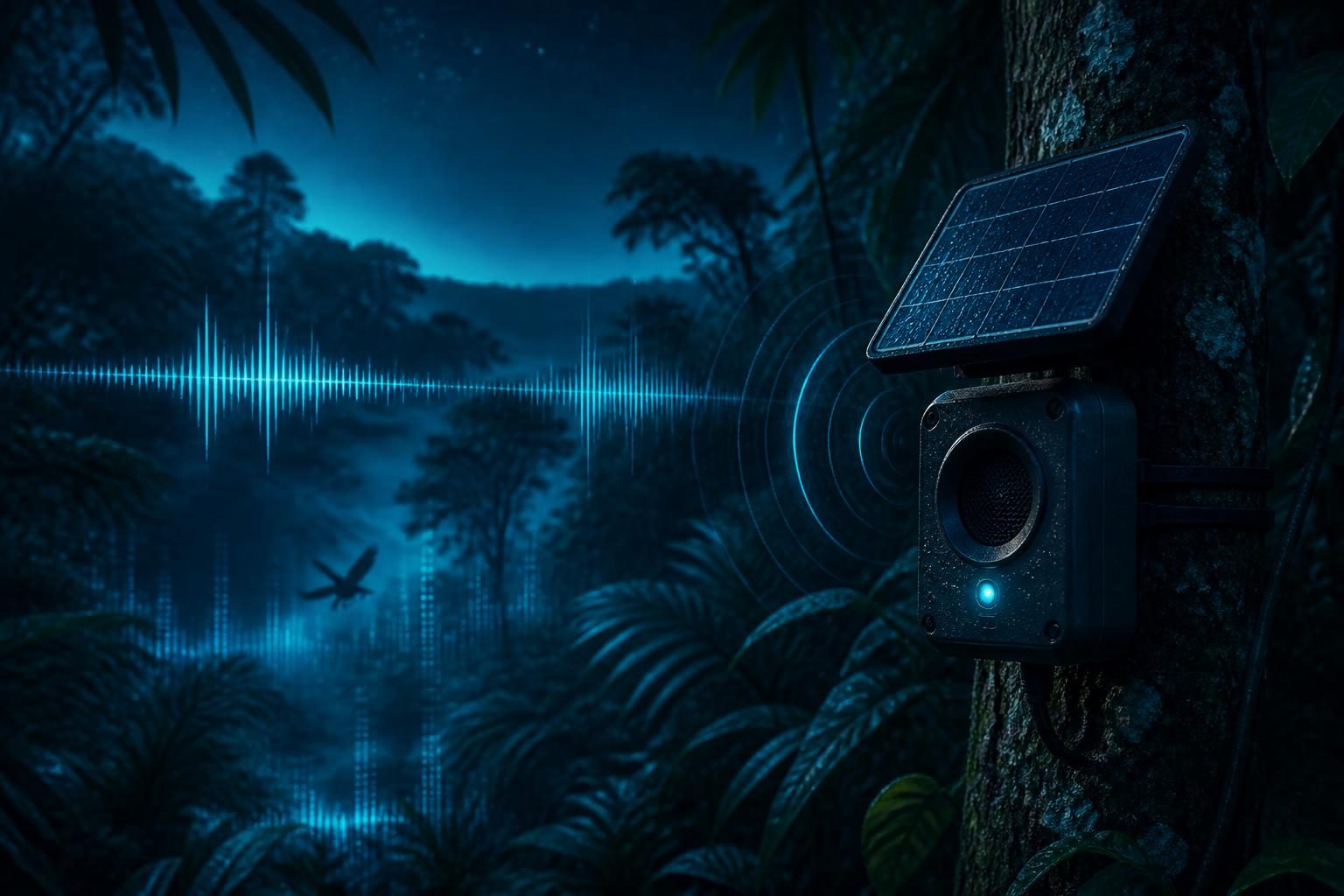
A conversation you can feel but not hear
Stand near a herd of elephants and you may sense something before you understand it — a faint pressure, a rumble that seems to come from the ground itself. What you're brushing against is a communication channel that operates almost entirely below the threshold of human hearing. Elephants produce powerful low-frequency rumbles, much of whose energy sits in the infrasonic range — below about 20 hertz, the floor of what human ears register. We share a landscape with these animals and miss most of what they're saying to each other, simply because our sensory equipment stops where theirs keeps going.
This isn't a quirk. It's a window into how much of the natural world's communication happens outside our perception — and into why building honest instruments to detect it is harder, and more revealing, than it first appears.
Why go low? The physics of long-distance sound
Low-frequency sound has a superpower: it travels far. High frequencies attenuate quickly, absorbed and scattered by air, vegetation, and terrain. Low frequencies shrug much of that off, propagating over long distances with less loss. For an animal that ranges across vast territories and needs to coordinate with others it cannot see, infrasound is the natural choice — a long-wave radio built into biology.
Elephant rumbles can carry across kilometers of savanna. Under the right conditions — still air, the cool of early morning or evening when temperature layering favors propagation — the reach extends further still. And elephants exploit an additional trick: some of that low-frequency energy travels through the ground as seismic waves. Elephants appear able to detect these vibrations through their feet and trunks, giving them a second channel — a seismic layer to their communication that we're only beginning to understand.
The upshot is a species conducting coordinated social life over distances and through media that would leave a human utterly out of the loop. Reunions, alarm, reproductive signaling, group movement — much of it negotiated in a register we can't hear and partly through a medium we don't think to listen to.
What the rumbles seem to carry
Careful field research, much of it built on decades of observing known individuals, suggests elephant rumbles are far from monotonous. They vary in structure in ways that correlate with context: contact calls that seem to help dispersed group members stay coordinated; calls associated with reunions; signals tied to reproductive state; responses to threat. Individual elephants appear to have recognizable vocal characteristics, and there's evidence they can identify one another by voice — a form of individual recognition threaded through the acoustic channel.
The honest caveat, which matters enormously, is the same one that governs all of animal communication research: documenting that calls vary with context is not the same as translating them. We can show, rigorously, that a certain rumble type tends to occur in a certain situation. We cannot say it "means" a specific sentence. The structure is real and measurable; the meaning remains a careful inference, and often an open question. Confusing the two is exactly the overclaim that erodes trust in the field.
The instrument problem
Here's where infrasound becomes a proving ground for bioacoustic technology. Most recording gear — and most of the models trained on it — is built around the range humans and birds occupy. Infrasound sits below that. Capturing it well demands equipment with genuine low-frequency response and careful handling of a stubborn enemy: wind noise, which pours energy into exactly the low frequencies you're trying to record. A rumble and a gust can occupy the same band, and telling them apart is non-trivial.
Then there's representation. Standard spectrogram settings, and the frequency scales baked into many machine-learning pipelines, tend to de-emphasize the very low end — either compressing it or, in the case of perception-based scales like mel, treating it as less important because humans find it less important. A model built around human hearing carries a human-shaped blind spot into the infrasonic world. Detecting elephant rumbles well can mean deliberately fighting those defaults: sampling and representing sound in ways that honor where the animal's energy actually lives, not where ours does.
This is a concrete example of a principle WAVE takes seriously across the board: the representation encodes an assumption about whose ears matter, and that assumption doesn't automatically fit the animal you're studying. Get it wrong and you can be looking straight at a signal while your instrument quietly filters it out.
What detection unlocks for conservation
Reliable infrasonic monitoring isn't only scientifically fascinating; it's practically valuable. Elephants are a conservation priority under pressure from habitat loss and poaching, and passive acoustic monitoring offers a non-invasive way to track their presence and movement across large, hard-to-survey landscapes. If a network of low-frequency sensors can register rumbles across a reserve, managers gain a continuous readout of where elephants are and how they're using the space — information that's difficult and expensive to gather by direct observation over such ranges.
There's an early-warning dimension too. Changes in calling behavior, or the sudden acoustic absence of a familiar group, can flag disturbance worth investigating. Paired with the seismic channel, infrasonic sensing could eventually contribute to detecting not just the elephants but events that affect them. The technology is still maturing, and the honest framing is that this is a promising direction rather than a finished capability — but the direction is real.
The humility the low end demands
Studying infrasound is a standing lesson in epistemic humility. We are eavesdropping, imperfectly, on a communication system evolved for a body and a sensory world profoundly unlike ours — one that hears with feet as well as ears, that reaches across distances we'd need radios to match, that operates in a register we can't perceive without instruments. Every step of the way, our tools impose our assumptions, and the discipline is to notice and correct for them.
That discipline is the whole point. The infrasonic world of elephants reminds us that "we can't hear it" is a statement about us, not about the richness of what's being said. Much of the natural world is communicating in channels our senses miss entirely — below our hearing, above it, through the ground, through the water. Building instruments honest enough to detect these signals, and disciplined enough not to overclaim what they mean, is how we begin to close the gap between the world as we perceive it and the world as it actually sounds.
The takeaway
Elephants have been holding long-distance conversations, in a register beneath our hearing, for as long as there have been elephants. We're only now building the ears to notice — and the notice comes with responsibility. Detect the rumble honestly. Represent it where the animal actually speaks, not where we happen to listen. And resist the pull to translate what we've merely begun to hear. The low end of the spectrum is a reminder that the natural world is far louder, and far more articulate, than our unaided senses let us believe — and that the first job of a good instrument is to stop hiding what we were never equipped to hear.
Listening through the ground, not just the air
One of the most intriguing threads in elephant research is the seismic channel. When a heavy animal rumbles or moves, some of that energy couples into the earth and travels as surface vibration. Evidence suggests elephants can detect these ground-borne waves and may use them to sense distant events and other groups. If that holds up broadly, it means the animals are operating a genuinely multimodal communication system — airborne infrasound and seismic vibration working together — and that a monitoring approach limited to microphones alone is capturing only part of the picture.
For anyone building detection systems, this is both a challenge and an opportunity. The challenge is that a purely acoustic sensor misses the seismic layer entirely. The opportunity is that pairing acoustic and seismic sensing could, in principle, yield a richer, more robust signal — cross-confirming an elephant's presence across two physical channels and reducing false positives from wind or unrelated noise. It's early, and it would be dishonest to present it as a solved capability, but it points at a future where "listening" to a species means more than pointing a microphone at the air.
What the animal's world asks of our tools
The recurring theme across elephant work is that the animal's sensory world sets the specification, not the other way around. If the interesting energy lives below 20 hertz, then sample rates, sensor response, wind mitigation, and time-frequency representation all have to be chosen to honor that — even when it means fighting the human-centric defaults baked into most gear and software. It's a discipline that generalizes: every species you study should prompt the question, where does this animal actually put its energy, and is my instrument built to see it there? Elephants make the question impossible to ignore, which is part of what makes them such an instructive case.